Thursday, 17 May 2018

GEYSERS AND MUD POOLS- NEW ZEALAND JOURNEY

BLOG POST 19

After the visit to the Agrodome ,we returned to our hotel for a small power nap after a light lunch as Tony had told us that we are in for a early Hangi dinner
Few of our members had gone for shopping and joined us at the Te Puia which is an iconic destination for visitors and fits its role as Kaitiaki (guardian) of Māori culture for future generations.
We were met by the two guides who were apparently  descendents of Rotorua’s earliest hosts.
After walking through the gates of Te Puia, we found ourselves standing beneath  Heketanga-ā-Rangi a contemporary Māori artwork  which reached skywards with 12 monumental carvings
There we were divided into 2 batches ,one to tour the geo thermal features and the other to see the cultural village and the New Zealand national carving and weaving center.
 We were in the first batch and left to see the geysers in a motorised waka (transporter)  a sort of a  train driven by a Maori lady  very proud of her heritage
 Rotorua's volcanic activity has drawn visitors to the region for generations and when it comes to things to do in Rotorua,  people say that no visit is complete without exploring its spectacular thermal parks and attractions.
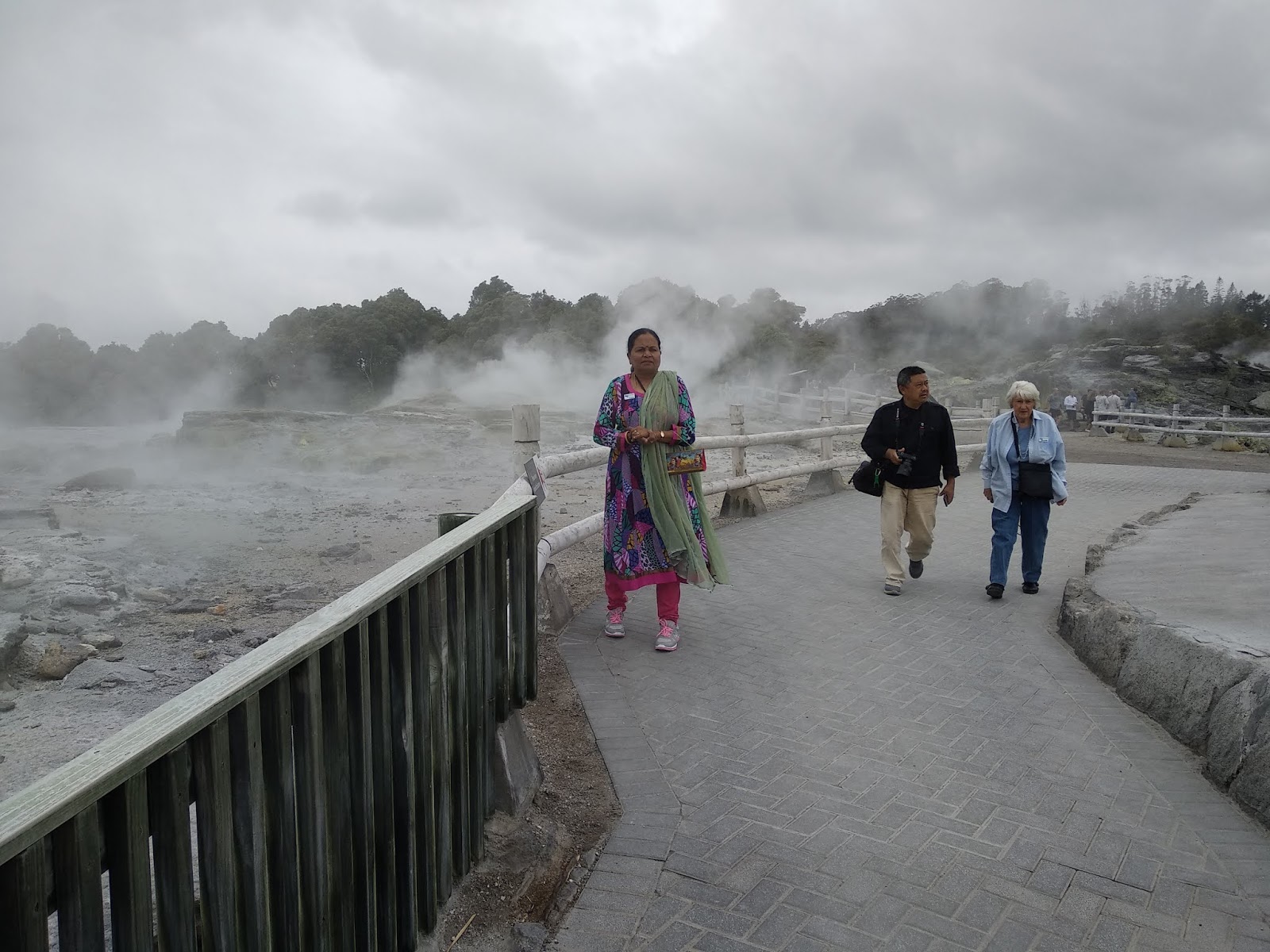
We were impressed and amazed by Rotorua's geothermal  features which included spouting geysers, bubbling mud pools and colourful sinter terraces.
 Geothermal water starts life as rainwater, which seeps down though cracks in the rock towards a heat source deep within the earth.
 Hot water is less dense than cold water, so it rises and emerges at the earth’s surface, sometimes as steam or mixed with steam.
 The hot water reacts with the rock it comes into contact with, and becomes enriched with dissolved minerals
 In 1901 the first open prison in New Zealand was established at Waiotapu, its object was to accommodate some of the better-behaved prisoners from jails of  Rotorua Lakes District.
A gang of those prisoners first discovered the clearing in which the geyser is situated and found that when they added soap to the hot water to wash their clothes, the geyser could erupt
 Geysers are a rare and spectacular phenomenon, hot springs which intermittently eject jets of boiling water and steam into the air. Their name is related to the Icelandic word geysa, meaning ‘to gush or spout’
 At Te Puia, Rotorua, the magma is only 6-7 kilometres below the Earth’s crust which accounts for all the activity of the surface.
Pōhutu, meaning ‘constant splashing’ in Māori the largest active geyser in the southern hemisphere  , regularly erupts to a height of 15–30 metres, and sometimes much higher. Prince of Wales Feathers, previously named Te Tohu a few metres north of Pōhutu, began spurting in June 1886, after the Mt Tarawera eruption probably triggered by earthquakes.
 Originally it was known as the Indicator, as it normally played shortly before Pōhutu erupted, but in 1901 it was renamed in honour of the royal visit that year. Since 1992 it has played almost continuously erupting to heights of up to 7 metres (21 feet)
Pōhutu is the most reliable geyser on Earth and eruptions last from a few minutes to much longer. About 15 years ago, Pōhutu erupted for over 250 days.
 Pōhutu has been visited by royalty and many other famous people. However, because nearby residents used bores to tap into the valley’s geothermal resources, Pōhutu was once at grave risk of losing its power. Fortunately, a program to close bores ensured that  Pōhutu continues to impress visitors once or twice an hour.

We had a fair share of looking at Pohutu erupting
Near the geyser there were rocks and our guide playfully asked us all to have a hot seat and relax our weary bodies for some time, all of us sat on the warm stones but two of our friends  shot up quickly and started rubbing their backs with embarrassed grins, we came to know that these rocks also tend to have cracks conveying the heat directly to the cracks in the stones LOL!
In the 19th century there were an estimated 220 of these erupting hot springs in New Zealand, but by 2004 only 58 remained. Whakarewarewa is now the only major remaining geyser field as most of the remaining geysers have been damaged or affected by human activity, especially withdrawing steam or hot water for heating
We went past the geysers to Ngā mōkai-ā-Koko, Te Puia’s largest mud pool. The mud in this pool was dark because it contained small quantities of black sulphur .The bubbling mud was like a live thing playfully pouting and spouting mud like naughty babies do. It was mesmerising to watch and we couldn’t take our eyes off it

I was thinking maybe after I die and go to hell it would look like this with sulphur smells, gushing geysers and bubbling mud pools , anyway let me face it when it comes I thought and brushing away the morbid thought I went ahead for a look at the elusive Kiwi bird because a visit to New Zealand wouldn’t be complete without meeting the national icon.
 Kiwi birds are nocturnal and incredibly shy .The kiwi is a nocturnal flightless bird and New Zealand’s national icon.
 Years ago there were about 12 million kiwi, but today there are fewer than 100,000 and this national icon is endangered.
The kiwi  bird is an important cultural icon to all New Zealanders, who call themselves ‘Kiwis’. In the late 1800s, the kiwi started being used as a trademark, and featured on one of the first pictorial stamps issued.
 During the early 1900s, New Zealand was depicted in sporting and other cartoons as a kiwi. During the First World War, New Zealand soldiers started being referred to as Kiwis.
Next we went on to the other guide our groups interchanged and we were shown around the  village and centres
Te Puia houses the New Zealand Māori Arts and Crafts Institute, established in the 1920s to foster all aspects of Māori culture. At Te Puia, national schools of carving, weaving and other traditional arts train talented students from around New Zealand under the guidance of master crafts persons

Traditionally, weaving and carving were vital Māori arts but by the 1920 they were in danger of extinction. Established in 1926, the New Zealand Māori Arts and Crafts Institute at Te Puia has seen carving, weaving and other traditional Māori art forms not only survive but thrive.
At the National Wood Carving School we could  see this prestigious art form being handed down from master carvers to young trainees. We watched as students practiced this  traditional Māori art .
At the National Stone and Bone Carving School students learn the revered tradition of carving pounamu (New Zealand greenstone), bone and stone. Students in this school also explore other materials and technical processes, including casting.
At the national weaving school students learn the ancient art of Māori weaving. We watched with fascination the weavers at work and interacted with them as they created garments of great beauty.
The flax weaving section had a very good display of woven items made from flax leaves - floor mats, grass skirts were created in a jiffy
The 3 ladies showed us how leaves were stripped into thin fibers which then were used for weaving.


Sunday, 6 May 2018

PARADISE VALLEY SPRINGS NEW ZEALAND JOURNEY


BLOG POST 16
After the visit to Glenbrook we proceeded to Rotorua ,on the way we stopped  at a place called Matamata, a town in the shadow of the Kaimai Range Mountains, on New Zealand’s North Island.

 Southwest of this town, the Hobbiton Movie Set was created for Peter Jackson’s “Lord of the Rings” and “Hobbit” films.
What was striking for me in New Zealand was that some places were similar to our local language
‘Matamata in  our Telugu language means being angry’
 As our itinerary was different we had a quick lunch with fish and chips and walked across to the park nearby, waiting for all our bus mates to come we did some window shopping and found quaint little paintings and other items done by local artists some of whom were found relaxing on easy chairs in the grass and doing their business cheerfully

We next went to Paradise Valley Springs which is Rotorua's must-see wildlife park. It is a 50 acred beautifully maintained park where we could interact with animals found wild around New Zealand,   This family-friendly attraction, set amid native bush, provided easy access along flat walkways in all types of weather and for people of all ages .

 We fell in love with this place, as it was very beautiful . We walked 2 hours around feeding and photographing very sociable farm animals - Alpacas  ducks, deer, wallebies, sheep, lamas, which were interestingly looking very friendly and they looked as if they were waiting to greet us and with us !

The girl who was looking after the farm animals though she said she had joined recently seemed to be very familiar with all the animals and was calling them all by their names . New Zealand has no native livestock, but a wide range of animals have been imported Farming is New Zealand's primary industry

There were an array of New Zealand and exotic wildlife, native birds in the aviary and waterfowl wetlands , We visited the Kea, New Zealand’s infamous and comical alpine parrots in their walk-through aviary, we found them preening themselves with gay abandon
Flowing through Paradise Valley Springs was the Ngongotaha Stream which is the major trout spawning stream for Lake Rotorua and Lake Rotoiti and approximately 20,000 trout spawn in this stream annually.

The Trout were totally wild and were free to come and go as they wish. There were hundreds of Rainbow and Brown trout in the natural stream as well as in the spring-fed display pools, and we could view them at eye level through an underwater window below their pool. We also spotted some large native long-finned eels lazing in their pools. 
Paradise Valley Springs had its own natural freshwater spring, Te Waireka (meaning Sweet Water).  Flowing from deep underground at a rate of 60 litres every second, this pure water provides a never ending supply to the trout pools, coffee shop and water bottling plant.
With glasses she had brought with her, our guide gave us pure New Zealand water from Te Waireka spring, we could also if we chose, take some bottled water away with us for friends and family to taste.

Long ago, before European settlement, local Maori tribes would bring their battle wounded warriors to Te Waireka spring to drink, as they believed these waters had healing qualities
Scientific testing showed the water from Te Waireka spring to be of a very high quality with excellent mineral contents.  In 2003 a small bottling plant began producing bottled water
Winding through open pasture areas alongside the Ngongotaha trout stream, the walkway was very wide with viewing areas  for the tourists to enjoy the beautiful setting.
We then went to the rainforest Treetops Walk. the solid boardwalk which was up to six metres (20 feet) off the ground in places, putting us right up in the tree canopy.We felt as if we were on top of the trees
The elevated walkway wound itself around mature native Tawa trees which were several hundred years old, through tangled vines and native plants, before lowering back down to ground level and exiting alongside a peaceful stretch of the Ngongotaha Stream. Along the walkway we found some old huts arranged in a very natural way
 In a separate area of the park there was a pride of African Lions, seen all day in an enclosure that allowed us to get very close to these wild animals. Lion feeding was at 2.30pm everyday which we unfortunately missed narrowly


THE AGRODOME TOUR NEW ZEALAND JOURNEY

BLOG POST 18
From the Luge rides down the Mt. Ngongotata, we went straight for the Agrodome visit. As soon as we got there, we were issued instructions how to proceed with the tour there  and how much time would we be spending there
The Agrodome is a 350-acre sheep farm located 10 km from Rotorua.
 It all started in 1970 when world champion sheep shearer Godfrey Bowen produced a show at World Expo in Osaka, Japan. His ‘Sheep Show’ was such a hit that Godfrey together with his friend and fellow farmer George Harford created a permanent home for it. The Agrodome opened its doors to tourists and Kiwis alike in 1971.
 In 1980 tragedy struck and a devastating fire completely destroyed the first Agrodome building. But undeterred, while the building was still smouldering, Ivan Bowen said, “the show must go on” and performed his famous sheep show on a hillside, to an audience of over 100!
In 1983, Warren Harford and Paul Bowen,sons of original founders of  Agrodome, joined the Agrodome team and started the second generation of this family business.
The Agrodome has won the coveted New Zealand Tourism Award for the New Zealand's Best Visitor Attraction a number of times; it is also a real working sheep and cattle farm with 1200 sheep and 120 beef cattle.

 As it was getting time for the sheep and the dog show we all gathered near the fence to watch a live dog trial where proficient farm dogs the border collies skillfully herded  the poor sheep through a number of obstacles, coming blissfully in between, there was a duck with its ducklings coming in the way of the exasperated dogs,it was very amusing

We then headed inside for an hour sheep show, it had a huge indoor stage with lots of seating and a pretty nice view for most ages and sizes. We sat quite close to the front as we wanted to ensure that we got to see the show well

Dressed in iconic black singlet, shearer's jeans and shearer's moccasins,our  cheerful and hefty host a shearer was very lively and informative ,helped by the live translation service offered through headphones in Korean, German, Japanese and Mandarin.
The host first introduced us to the various variety of sheep from around the world at the same time explaining the specialty of each one. During the one-hour show we were shown the range of New Zealand sheep breeds  

Rare breeds at the Agrodome included:
Arapawa Sheep, A Rare Breed of New Zealand Origin, Dorset Horn Sheep, A Rare Breed of British Origin, Damara Sheep, A Rare Breed of African Origin, Karakul Sheep, A Rare Breed of Middle Eastern Origin,Dorper Sheep, A Rare Breed of South African Origin,Drysdale Sheep, A Minority Breed of New Zealand Origin,Gotland Pelt Sheep,  A Rare Breed of Baltic Origin,Jacob Sheep, Origin unknown,Pitt Island Sheep, A Rare Breed of New Zealand Origin. 
 It was amazing to see how the sheep when called, fell in line and climbed to their designated spot in the stage and started munching on their goodies placed in bowls before them ,we were amused to see some sheep snatching the bowl of other sheep too ,I thought pigs are not only the ones greedy !

The host explained that some of the sheep had wool which had a very high rate in the market
We were entranced as he demonstrated the way to shear a sheep who tried its best to wriggle away from his clutches ,at the end of the shearing I didn't realise how much wool came off a sheep .The poor sheep tottered off deprived of its wool covering looking  utterly miserable “never mind you will grow it back again” was the comforting thought I sent across to it, At every stage our host  who was helped by two pretty petite girls was involving the audience and calling us onto the stage

After the shearing, few men and women from the tourists were called on to the stage to milk an enormous big eyed cow who looked vexed and impatient but luckily didn’t kick anyone
Then the children were called and given milk bottles to feed small lambs it was indeed funny to see the lambs following the kids but the Marys were too timid to withstand the onslaught of the hungry lambs and were ready to break into tears

During all this, the dogs were seen sitting at their allotted places very disdainfully and jumped over the sheep when called for , the show was genuinely entertaining

After the show we could get onto the stage and pet the sheep which were plump and heavy and could easily eat out our hands if they wanted to but they sat watching us very placidly
At the end cackling merrily the duck arrived with its flock
On the way out we could see the nursery where we could see the young animals the lambs and the alpacas being looked after so well
We visited the Woollen Mill and could see authentic Platt wool-carding machine from 1906 and learnt how wool gets from a sheep’s back to our own ,saw a demonstration of wool processing and spinning using wool shorn from sheep during the farm Show.
 The Woollen Mill had a range of homespun, hand knitted/woven garments along with handcrafted footwear, rugs, knitting and weaving kits. Many of the products in the Woollen Mill were made of pure New Zealand wool ,be it sheep, alpaca, opossum or angora..

There was a Dog and Whistle Gift Shop selling Sheepskin products, Lanolin creams, Woollen clothing, Leather goods and New Zealand souvenirs

There were other activities at the site like farm tours and carthorse trips but we only had time for the shows.

Finally we left the place feeling definitely very wooly ! During our tour around New Zealand I had wanted to stop many times to take pictures of sheep and get close but the time or driving conditions didn’t permit. The visit to the Agrodome satisfied this desire to get close to the sheep


Sunday, 29 April 2018

MOST EXCITING RIDE OF MY LIFE -NEW ZEALAND JOURNEY


BLOG POST 17

Finally we reached Rotorua ,I suddenly saw steam coming out from the ground and my instant thought was” oh God there is a fire !” and spelt it loud, immediately to be shut down by my husband who caustically said “my dear we are in geyser and hot springs land, the one and only Rotorua
Situated on the southern shore of a lake is Rotorua, one of New Zealand’s largest tourist destinations, a geothermal paradise that has attracted visitors from around the world for over 160 years.
 It is renowned for its fascinating Maori culture, its hot springs, boiling mud pools, spouting geysers, warm geothermal springs and silica terraces.
Rotorua is rich in Maori culture and is home to the ‘Te Arawa’ people who settled here 600 years ago, today they offer the visitor the opportunity to experience authentic traditional Maori villages, such as the Buried Village, Whakarewarewa, Te Puia, Mitai and Tamaki Maori village.
We alighted at the The Sudima Hotel Lake Rotorua that enjoys a location that is second-to-none on the very shores of beautiful Lake Rotorua, adjacent to the world famous Polynesian Spa complex ,after freshening up we had a walk around ,seeing the lake Rotorua and gardens, there sure was a distinctive, sulfurous smell of geothermal activity  
We settled into the peaceful lakeside setting and enjoyed lush spa therapy in mineral spring hot pool at Polynesian spa while taking in the views of Lake Rotorua. The spa was voted among the world's Top Ten Spa's by Conde Nast Traveller Magazine.
 We were strictly instructed to remove all metal ornaments as they would simply dissolve in the water
That night during the complimentary buffet dinner suddenly Tony announced a cake cutting ceremony for a lovely couple from Australia. It was the 50th wedding anniversary of the young looking couple, none of us could believe it, apparently they were married very young at 17 and 15 yrs
Next day we got up and left for Rotorua’s most popular attraction ‘Skyline Gondola’  which is a scenic ride to the top of Mt. Ngongotata which has a dormant volcano and is 487 metres above sea level . The 900 metre long Doppelmayr cableway system transported our group on a gentle, scenic ride up to the Skyline Rotorua complex.
 The gondola was very clean and the view from it was awesome ,we could see right across to the entire city  with its spectacular geothermal vistas ,it sure needed us to get used to the sights of steam arising randomly across the city and beautiful blue lake with lovely slopes ,lush gardens with beautiful flowers and sheep gazing the grass and looking at us sleepily wondering what we were doing so early in the day


We were immediately directed us to the cableway restaurant where we had the best breakfast of our tour in north island , coupled with decor of the restaurant ,warm service and the panoramic views through the big windows it was a culinary and visual treat for all of us

After the breakfast Tony came to us with the news that now we could go for the luge ride. Luge, a gravity-fueled ride where we can zoom down the side of a mountain in a four-wheeled cart,with a unique braking and steering system before catching a chair lift to the top to do it all over again.This is where the luging adventure all began in 1985.

 For the whole family, Skyline Luge has three tracks of differing skill levels winding through numerous twists in a beautiful red wood forest.
Now we went through the precautions to be taken before riding the luge and there was a big list which included, among other rules that one must be in good health and be free of height conditions, motion sickness, back problems or other physical limitations. Expectant mothers should not ride.
This made me hesitate as I had slight cervical spondylosis but I saw our valiant friend who had a recent hip replacement striding forward to take the helmet and I steeled my nerves and divested myself of the handbag to our Tony who loaded himself very sportively with all our lose articles which we were not supposed to take on the luge

We went to select the helmets feeling like warriors going for a dangerous ride


After a short wait we stepped into the luges ,listened to the instructions and got going ,I was too engrossed in handling the luge to look around and within minutes we were at the bottom of the hill and rode  the Luge chairlift back to the top of the track with our luges attached to it ,on the way we had a wonderful view.It sure was an exhilarating experience ,I was glad I could get rid of my inhibition and do the best ride of my life


 Once up top, one can choose to Luge, Mountain Bike, Zoom Zipline, Skyswing, check out the nature trails, shop at the Jelly Belly Store, enjoy Volcanic Hills wine tasting and dine at Market Kitchen or Stratosfare Restaurant. 

As per our tour schedule we had  time only for a look at the jelly belly store where we could see famous paintings like the Mona Lisa created using over 18,000 jelly beans and bought some jelly beans from a selection of over 100 flavors of gourmet jelly belly beans


Thursday, 5 April 2018

CHUGGING AWAY IN A STEAM TRAIN -NEW ZEALAND JOURNEY


BLOG POST 15

 From Bay islands after seeing a helicopter at close quarters  doing coast guarding we travelled on our way  south via Whangarei to Auckland's north shore, the trip which lasted for 3 and half hours, tired after the exciting cruise we all had a good nap interspersed by Tony and Megan’s jokes.

Tony produced lollies unfailingly every single day of our tour, after half an hour he would come back with an empty cover to take back the rubbish . As we travelled back to Auckland we got to see stunning views of Rangitoto Island, Auckland Harbour and the Hauraki Gulf.

 Our accommodation was the Spencer on Byron, Takapuna, Auckland.We were very impressed by the hotel which  had unsurpassed panoramic views of Rangitoto Island, Auckland Harbour and the Hauraki Gulf. Our hotel was located just 500 metres from Takapuna  a central, coastal suburb of North Shore, Auckland .

 Our room was a single bed room suite with suite lounge , sitting area with section sofa and TV , with wonderful views  over Takapuna to Auckland CBD, the views were panoramic  and  at night the sky gave  glittered with splendid and sparkling night views of Auckland .

There was a  Suite Kitchen,separate bed room, very comfortable beds, large mirror door closet and good selection of complementary toiletries. We were able to do our washing in the well equipped living area fitted with a washing machine and dryer and had complimentary washing powder, while relaxing in the lounge, both the lounge and bedroom had picture windows maximising the views.


The hotel had a club bar – breakfast room with adjoining room having frames with all VIP signatures, the lobby had a vertical garden and a lovely library.

The restaurant was the famous thyme restaurant. We had one of the best breakfasts on our tour at this hotel and started to Rotorua
On the way we first went to the Glenbrook Vintage Railway (GVR) which is a heritage steam railway in Glenbrook  We felt a special attachment to GVR as my husband’s initials are also GVR ,Godha Venkata Ramana .
The GVR is run by a trust board of three trustees elected and appointed from Railway Enthusiasts Society (RES) membership. 
It is dedicated to the one of the world's leading working preservation railways with some of New Zealand's best examples of great Kiwi Locomotive designs that made the world envious.
It houses many different types of unique locomotives ranging in size from 3 tonnes to 110 tonnes, both steam and diesel. GVR prides itself for an extremely high standard of restoration, frequently winning special awards for locomotive, rolling stock and building restoration work.


We found out that all this is carried out by volunteers from as young as 8 to as old as 80, these volunteers freely donate their time and efforts to ensure the success of this rewarding and historically significant project
.
Newcomers are trained by experienced people and standards are high with a quality of service and safety second to none, any one willing to spend time from just a few days to weekly or more often, throughout the year are said to be welcomed here.

 Various jobs are done by people from all walks of life in their spare time volunteers carry out a wide variety of tasks - ticket sales, souvenir shop and refreshment shop sales and preparation, motor and hand jigger operation, crowd control, assisting disabled passengers, ensuring tidiness of the station and facilities, public announcements and other mundane jobs

Guards travel on all passenger trains to look after the passengers, help them on and off the trains, check their tickets, answer any questions and make them welcome. Guards assist in testing the train brakes, signal to the driver when the train is due to depart helped by an Assistant Guard

The Glenbrook Vintage Railway (GVR) operates over 7.5 kms of track from Glenbrook to Victoria Avenue in Waiuku with a further 500m extension onto Tamakae Reserve in Waiuku in the pipeline. They operate every weekend and most public holidays  ranging from Labour weekend to Queen's birthday weekend.

  Since the opening of the Glenbrook Vintage Railway in 1977 the entire track, which formed the original Waiuku Branch, has been replaced, in many places more than once, and extensive yards and sidings have been laid where none previously existed. This has all been the work of a well equipped, enthusiastic group of volunteers.


Trains depart from Glenbrook every 90 minutes starting at 11:00 with the last train at 4:00pm.

We were in time for the 11 am trip and we were greeted by the station master as soon we went into the station. The train came into the station huffing and puffing ,we got in and came to know normally passengers are welcome to alight at Victoria Avenue and explore the township of Waiuku and catch a later train back to Glenbrook but we  were on a tour package so we travelled only part of the trip. 
After travelling for some distance where we could see the country side and houses lining on both sides of the track, we went to the workshop at Pukeoware where the railway society has its workshops and several other engines are stored.


We found the volunteers maintaining their running locomotives in top condition and restoring others to operation. Workshop was well equipped and ensured that most repair and restoration work on locomotives could be completed on site. 
We also could get to see the Thomas engine which the kids really loved apparently
 The railway had a number of historic station buildings in its care, interestingly all being from former New Zealand Railways stations.
Glenbrook Station's terminal building is made up of the original Waiuku Branch line Glenbrook station and Patumahoe station buildings.
Glenbrook Station's picnic area shelter (and eventual platform 2 building) is the former Kingsland suburban station shelter, moved to Glenbrook in 2003 to make way for the double-tracking of Auckland's Western line
We found that all these buildings have been restored with so much love and care that they looked brand new
Special Events are often held, such as "Friends of Thomas" (the tank engine) weekends, Rail fan Days (with display freight trains and double decker buses), Country and Western days and night steam runs
After the ride in the train which had seats which could be twisted both ways both onward and return journeys, we went and stood on the outdoor covered viewing platform to get the real feel of the train journey .
We finally got down at the station where we were given tea, coffee and snacks by the lady volunteers,tea and coffee was served in pots covered with dainty  doilies
 we could also see the display of age old luggage  of passengers stored  and displayed so carefully for posterity.

 GVR went that extra mile to recreate the "Steam Theme" and helps people understand and enjoy the sights, sounds and smells that could only be found the golden age of steam.
Specially the young generation which never experienced the steam engines really enjoy this trip. All volunteers working as staff greeted us wearing the exact uniforms worn in that era.
We felt as if we had travelled back in time, as all of us had experienced the steam engines in our childhood, gone through the coal engine days, when sitting by the open windows we could feel the soot settling on our faces and body and by the end of the trip we would become as black as crows and would wear out the soap clearing the soot after going to our respective destinations.

We departed Glenbrook thrilled with happiness, having experienced the steam rail journey,memories of which we had long forgotten and began travelling through magnificent countryside of rolling hills and green pastures famous for dairying. We found all through our  New Zealand tour the cows and sheep busy nibbling the amply found grass and never had a moment to look up and see the the nosy and noisy tourists.
We continued to Rotorua to visit Paradise Valley Springs,


OUR HOLY VISIT TO SRINGERI

We wanted to visit Sringeri for a long time, and finally we got the chance to visit one day. We started from Mangalore early in the morning;...