We checked into Fish Tail Lodge our resort in Pokhara and quickly freshened up and started our day tour.
We wanted to go to Sarangkot, a 5860-foot-tall hill situated on the western side of Pokhara and known for its panoramic Himalayan views of Dhaulagiri, Annapurna, and Manaslu.

The hike up from Pokhara Baglung Highway at Miruwa to Sarangkot normally takes 90 minutes to 1.5 hours and is a scenic one, but we didn’t risk it, we went in our car to the Annapurna cable car station at Seti Nagar for a cable car ride to Sarangkot.

Before dropping us off, our driver told us to ring him before starting our return cable car journey so that he would come and pick us up at Seti Nagar station.

The cost of a round trip ticket on the Annapurna Cable Car was NPR 800, and for Nepalis, NPR 700.

Luckily for us, there wasn’t much rush, as the tourists go there mostly at sunrise or sunset to see the awesome views from the view tower at the top.

A motor car ride, which would take 40 minutes up the undulating roads, would now take us only 9 to 10 minutes by the cable car.
We took the tickets and waited for our turn. A young female solo traveller was with us, and I asked her from which country she was coming. She said Ukraine, I wondered at this time of active war how the citizens were traveling but didn’t voice it aloud, paying heed to my husband’s meaningful glances, the person monitoring the cars was an Indian from Kerala and had worked in the Indian army till his retirement.

As we went up smoothly, we could get an excellent view of the entire Pokhara city, including the Phewa lake .

Down below us, as we were passing by, we could get glimpses of peaceful, relaxed village life with quaint little houses and animals, mostly goats. Most of the houses had flowerpots on their terraces and front yards, flowerpots brimming with lovely flowers and colorful clothes drying on clotheslines and fluttering in the wind.

Some of the houses were homestays as evidenced by the welcoming boards; we came across many tourists trekking up the hill.
We could see cars and an occasional bus going laboriously up the winding serpentine roads.

We arrived at the alighting point and walked down to the viewpoint. There was an elevator that led to a view tower, which had the most divine views from the top and offered freshly brewed coffee for the tourists for sale.

One of the largest mountain ranges in the world, the Annapurna range, and Annapurna, the 10th highest mountain in the world, were visible from the view tower.

I wondered if man can ever surpass nature in any aspect; the tall, proud, mighty mountains glittering in the bright sun took my breath away and filled my heart with peace and humility.
There was a small Shiva temple at the top that acts as the hub of celebration on important festival days, To pray, I respectfully removed my sun hat, which I had been carrying around the world for the past 10 years and placed it on a ledge there. I forgot to retrieve it and missed it only after coming down alas, I thought maybe it was fed up with me!

There were a lot of activities going on at Sarangkot; we could climb up a path and do wildlife viewing, but we were told that occasionally a tiger or leopard is known to stroll across, probably to see the beautiful sunrise or sunset, so we didn’t want to be delicious kababs for them. Those interested could also do top-notch bird watching.

Sarangkot is the launching point for one of the longest and fastest ziplines in the world that starts at the top of the mountain and runs down to the valley below.
We could see the tandem swing offering a 45-foot fall and lasting for 4 to 5 minutes; there were young tourists trying it, and I enjoyed the excitement on their faces because it was like they were flying directly into the sky.

There was a sky cycling spot with the cycling rope suspended above the ground, and people were cycling on it with gay abandon with no fear of falling.

My husband was, meanwhile, trying desperately to reach our driver, who wasn’t lifting the phone. I muttered to myself, lo! Here start our troubles again, however, this time we had taken the main agent’s number too. After hectic calls to him, he finally answered and told us that he had given the wrong phone number and that the driver would come and pick us shortly.
After this fiasco we wanted to have lunch and were taken to a small restaurant where there were loads of Indian tourists all eating dhal chawal. The hotel owner gave some free gyan to us as to why Indians want to eat only Indian food and not try the local cuisine; we had no answer, we smiled and went out after eating a masala dosa each.
Our driver stopped at a parking lot and asked us to go the Devis Falls and also the Cave, which was just adjacent to it.
Particularly in Nepal, I have seen the tour agents send their customers without giving any information about what to see and do, so one needs to do a lot of research before going to these places.
We walked down to the Gupteswar Mahadev cave, whose entrance was almost hidden by the stalls selling religious items and souvenirs,

We did a little shopping mainly for our little grandson staying in US; we could get a typical Nepali dress and some beads. The shop owner was a lady who also came from India and had worked in the Army.
The cave, which is 100 feet deep and 6750 feet long, was allegedly discovered in the 16th century by some local men who stumbled upon it accidentally. Within the dark cave, they discovered many shrines and statues dedicated to Shiva and other Hindu deities.
There was an entrance ticket of 100 Nepali rupees, and when we went further, there was a spiral staircase adorned with statues depicting Hindu mythological figures.


We went down this staircase and saw an entrance gate with carvings saying "cow shed cave entry." Some people panting and drenched with sweat were coming out of the cave.
Seeing them, I had second thoughts about going in, but having come so far decided to brave it, the minute we entered, we discovered, to our dismay that it was almost pitch dark there and we had not taken any torches with us.

The incoming and outgoing paths were blending and we were totally boxed in on either side by the mountain. There were many narrow tunnels, in areas of very low height, which needed us to stoop down, and water was dripping from the roof, making the steps extremely slippery.
As we had to remove our shoes at the entrance, it was all the more scary. I had vivid thoughts of falling and getting hurt or sustaining a fracture and clutched the support rods for my dear life. Seeing my scared face, few people who were returning from inside told me it was not very long, and I could do it.
I wouldn’t advise a visit to this cave, for elderly people and those who have claustrophobia.
I heard someone commenting that the Cave reminded him of the Movie "Journey to the Centre of the Earth".

After cautiously going down in the dark, we could see the naturally formed stalagmite Shivling. Photography was prohibited, though there were people taking snaps in total disregard for the rules. We were told that during the rainy season, the water from the falls would rise up to the linga and do abhishek to it. During those days, tourists are prohibited from going further down to the falls.
At the end of the cave, as we walked or rather stumbled blindly, there was a slit of bright light in the rock that showed the bottom half of Davis Falls. We could clearly hear the water roaring, the path here was very uneven and we could see the ground crumbling in a few places.

By the time we came out, we were also wet with sweat and the water from overhead; our legs were protesting at the unaccustomed exercise, and we sat for some time resting, presumably appearing to look at the statues around us.


The other legend is that of Mrs. Devis, a Swiss tourist, who was swimming in the Fewa Lake in July 1961, and when the dam unexpectedly started to overflow, she was swept down the waterfall, so in her memory, the falls have been called Devis Falls, which gradually changed to Devi’ falls.

We entered through the gate and were anxious as to how far we had to climb down to see the falls, luckily, they were quite near.


There was a park with few statues but it needed to be spruced up, the path to the falls was overgrown with wild plants and ground strewn with plastic bottles and rubbish, the falls was worth seeing and in rainy season would be spectacular .


Seeing the rocky mountains around the falls, I wondered how foolish people can be, to swim in such dangerous spots, my husband reminded me that this is an adventure for some.

There was a small wish pool where we had to wish and put in coins to see whether they would hit the exact spot; some enthusiastic, brave people had even put some rupee notes in, and a few stalls with native Nepalese attire for hire were available.

Our next visit was to the second tallest Shiva statue in Nepal , after Kailashnath Mahadev Statue in Pumdikot, a hill station in Kaski District of Gandaki Province with a viewpoint at an altitude of 4920 feet above sea level .


We had a few moments of anxiety with the car slipping backward due to sand on the road which was very rough .
As we got out of the car and walked up the cement road, we had picturesque views of Annapurna Himalayan Range, Machhapuchre, Dhaulagiri, Manaslu and many other neighbouring mountains with the Fewa lake and valleys.
High above us towered Lord Shiva in a sitting posture, the statue was 51 feet tall, sitting on a stupa 57 feet in height.

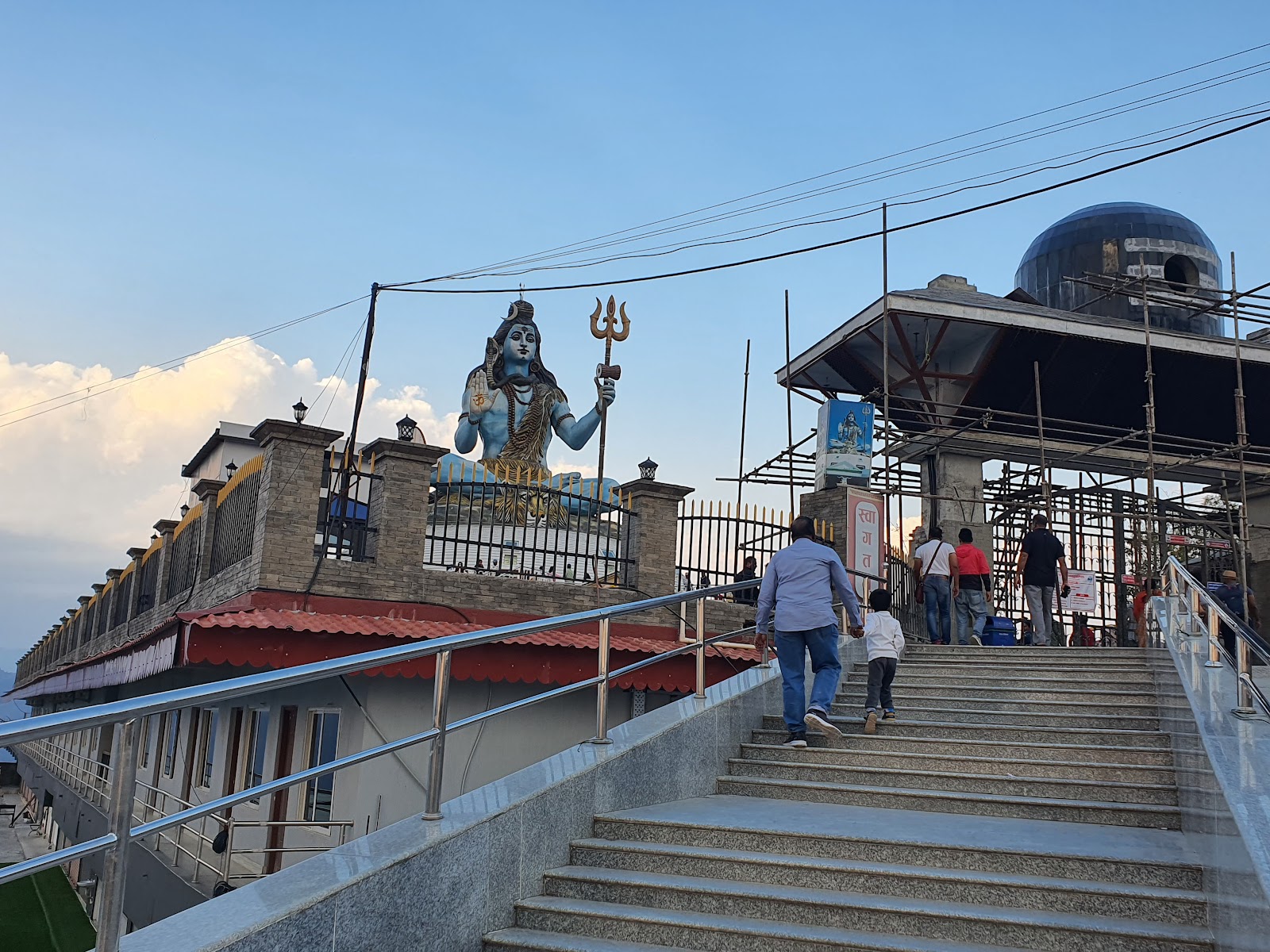
Slowly we ascended the steps, we could see a lot of construction activity going on. There are plans to construct Martyr’s Memorial Park; a model of Mount Sumeru featuring Shiva and Parvati is also in the pipeline.
We were greeted by a big golden Nandi, a Shiv linga and a big Ganesha; we had to go up some more steps to see the Shiva statue properly.


There were 108 Shiva lingas encircling the statue at its base.

While we were there, we found groups of local Nepalis coming to visit the place for a picnic, while the younger Nepali boys and girls were dressed in modern Western wear, while the older Nepali women were dressed more conservatively, I took permission and snapped few pics with them


We made a circuit around the statue and found the Annapurna mountain range views enthralling; there was a big damaru model.

As we were looking around, we saw lights slowly appearing in some parts of Pokhara and dark clouds appeared in the sky.

We rushed down, as we still had to visit the famous Tal Barahi temple situated in the center of the Fewa Lake and one had to take a boat to go there, as an anticlimax by the time we reached that place we came to know that the temple was closed for the day.

In Nepal I found that temples close quite early, latest by 7 pm, we however attended aarati by the lakeside where the local Nepalis and tourists alike were freely dancing and we returned back to our resort putting an end to another day .


No comments:
Post a Comment