Few years back my husband and I had visited Khajuraho for a Sexology conference and I was very excited to go there as it is very well known for its famous temples and sculptures

Khajuraho, a town in Madhya Pradesh is located in Chhatarpur district. The name "Kharjuravāhaka", is derived from Sanskrit kharjura date palm and vāhaka - "one who carries" and has the largest group of medieval Hindu and Jain temples, famous for their erotic sculptures
The Khajuraho Group of Monuments has been listed as a UNESCO World heritage site and is considered to be one of the "seven wonders" of India

Khajuraho is approximately 1300 km from Hyderabad. The fastest way to reach there from Hyderabad is by flight via Varanasi which takes approximately 4 hours and budget friendly way from Hyderabad is by train via Bhopal which would take approximately 26 hours.
We went there from Indore by train as we had visited Ujjain, when we arrived at Khajuraho we found that it was a small place, peaceful and rusty
The city was the cultural capital of Chandela Rajputs, a Hindu dynasty that ruled that part of India from the 10-12th centuries. The political capital of the Chandelas was Kalinjar. Khajuraho has no forts because the Chandela Kings never lived in their cultural capital.
The Khajuraho temples were built over a span of 200 years, from 950 to 1150 A.D most of them by kings Dhangadeva and Yashovarman near Mahoba which was the Chandela capital.
In the olden days the whole area was enclosed by a wall with eight gates, each flanked by two golden palm trees. There were originally over 80 Hindu temples, of which only 25 now stand in a reasonable state of preservation, scattered over an area of about 6 square km.
Around 1022 CE, the town was the target of the ruler Mahmud of Ghazni, but his raid was luckily unsuccessful, and a peace agreement was reached by the ruling Chandela King Vidyadhara.
Khajuraho was notably invaded and seized by the forces of the Delhi Sultanate under the command of Sultan Qutb-ud-din Aibak in the early 13th century. In 1495 CE, Sikandar Lodi launched a campaign of temple destruction all over India, where the statues in all temples were either beheaded or faces mutilated and limbs severed, the whole intention was to disfigure them and render them unfit for devotional purposes, unfortunately the campaign included even Khajuraho which suffered heavily
The Chandela dynasty, which built the famous temples, eventually declined and the remoteness and isolation of Khajuraho protected the Hindu and Jain temples from continued destruction by Muslims
Khajuraho thus fell into obscurity and was covered by the jungle for centuries, by 16th century the temples were completely covered by vegetation and almost hidden from the world and Khajuraho became an insignificant place which fortunately helped preserve most of the remaining temples from further destruction.

Locals living in the Khajuraho village always knew about and kept up the temples as best as they could but the jungles started taking a toll on all the monuments.
The temples were "rediscovered" by C. J. Franklin (a military surveyor) in 1819 and in the 19th century, British engineer T.S. Burt arrived by chance in the thick jungle area, he was then followed by General Alexander Cunningham who put Khajuraho on the world map when he explored the site on behalf of the Archaeological Survey of India and described what he found in glowing terms.

I personally always wonder why our hill stations, temples and monuments need discovery and subsequent publicity by the Europeans and not us the local people
Alex Evans, a contemporary stonemason and sculptor forensically examined the tool marks and construction techniques involved in creating the stunning stonework at the sites and stated that the sculptures involved a lot of skilled work and transporting the heavy stones would have required hundreds of highly trained sculptors and workers
We went to the temples early so that we could go around and see before the regular tourists arrive, visiting hours of the temples being 8 am to 6 pm
The Khajuraho temples were set in a parkland landscape with mowed grass, rose beds and plenty of ornamental trees, this gave a perfect setting to the majestic and stunning sculptures
However we found to our dismay that many sculptures at the Khajuraho temple complex are damaged, a result of historical invasions and the passage of time.
A notable example is a magnificent seven-foot-tall headless idol of Lord Vishnu at the Javari Temple.
There were broken statues and artefacts strewn pathetically around the temple grounds, with some pieces integrated into existing structures as part of restoration efforts.
The remaining temples and sculptures are now primarily under the jurisdiction and protection of the Archaeological Survey of India. The ASI focuses on preservation of the ruins in their current state rather than reconstruction of damaged idols.

I felt that the damaged sculptures were standing as mute historical testaments to the region's turbulent past but the intact portions continued to showcase the superb mastery of ancient Indian art and architecture.
Today, the temples serve as fine examples of Indian architectural styles that have gained popularity due to their explicit depiction of sexual life during medieval times for which tourists from all over the world regularly arrive to behold and try to decipher their intricacies

Except the temple of Chaturbhuja, all temples face the sun as is common practice in Hindu temples and run on the basic mandala design comprising a square and circles
The temples are grouped into three geographical divisions: Western, Eastern and Southern.
Majority of temples fall into the Western group and are famous for their intricate carvings and architecture, are located near the archaeological museum, this group is considered one of the well managed and concentrated temple sites at Khajuraho

The temples include Kandariya Mahadeva, Lakshmana, and Vishwanatha temples. Chausat Yogini temple, Jagadambi temple, Chitragupta temple, Matangeshwara temple, Vishwanath temple and Varaha temple.
Kandariya Mahadeva temple is the largest one, quite intact and dedicated to Lord Shiva, it is the most famous and features a towering spire and detailed carvings.
Lakshmana temple is dedicated to Lord Vishnu and is also known for its elaborate carvings.
Vishwanatha temple is another significant temple in the complex and Chitragupta temple is dedicated to the sun god Surya.

Varaha temple is smaller but historically significant and dedicated to the boar incarnation of Lord Vishnu.
Matangeswara temple is dedicated to Lord Shiva and still being used for worship
Eastern Group of Temples comprise Ghantai temple, Parasvanath temple, Adinath temple, Brahma temple, Hanuman temple, Javari and Vamana temple these are mostly carved Jain temples which reflect that Jainism flourished in this region during Chandela rule while the Southern group has only a few temples which include Beejamandal temple, Dulhadev temple, Jatkari and Chaturbhuj temple which are mostly scattered.
Eight temples are dedicated to Vishnu, six to Shiva, and one each to Ganesh and Surya while three for Jain tirthankara.
We visited the Western group of temples along with the local guide, they had their famous Nagara style of architectural symbolism and are made of sandstone with granite foundation. The builders didn't use mortar, the stones were put together with mortise and tenon joints and held in place by gravity. This form of construction requires very precise joints. The columns and architraves were built with megaliths that weighed up to 20 tons that were brought from Panna area


Some external carvings have erotic art and some of the temples have two layers of walls with small erotic carvings on the outside of the inner wall of the temples
Most of the sculptures are depicted engaged in various forms of sexual and sensual practices and it can be said that no act of sex no matter how outrageous is off limits at the Khajuraho temples.

Not only are there levels upon levels of mindboggling intricate sculptures of sexual acts in groups across various impossible positions, there are threesomes, oral sex, men and women masturbating and even depictions of animals engaged in naughty behavior with humans, definitely things were so permissible that one cannot imagine that such thinking and practices existed 1000 years ago in pre-Mughal and Pre-British eras

We asked our guide about the erotic art and the mistaken linking of Khajuraho to Kamasutra
He told us that according to our scriptures before going to the deity, one must leave sexual desires outside the temple because divinity is pure like the atman, which is not affected by sexual desires
In olden days, before the Mughal conquests, boys lived in hermitages and followed celibacy until they married, they may have learnt about the world and prepared themselves for marriage by examining these sculptures
While the sexual nature of these carvings have caused the site to be referred to as the Kamasutra temple, they do not illustrate the meticulously described positions, neither do they express the philosophy of Vatsyayana's famous sutra
I observed that many of the tourists were looking with fascination at these erotic sculptures, to my amusement I saw one western tourist lying flat on his back on the ground looking very intently at the statues, some of the tourists even had copies of the Kamasutra book with them
As we were looking I saw one family approaching and the husband sternly instructing his curious wife to take their children to play in the park, I could guess that the poor wife too wanted to have a look at this erotic art but she had to obey her husband Alas!
I could see that in the majority of cases the external curvature and carvings of the temples depict human beings with intricate details about their bodies like the muscles and tendons, exquisite jewelry and the changes that occur in human bodies

The sculptures depicted everyday life of the common Indian at the time when the carvings were made and some of the male sculptures had beards and unshaved faces


I saw statues of surasundari such as apsara and mythical figures performing daily routine activities like women putting on makeup, applying sindoor to foreheads and kohl to eyes, wringing hair after head bath, yawning, stretching their body languorously and admiring themselves in handheld mirrors or simply posing provocatively and daintily removing a thorn from the feet, a man can be seen probably going to the market with a bag , a mother is holding a small infant


We found a sculpture of a loving couple ,were theirs lips colored ? I wondered seeing their red lips

There were ornate ceilings so delicately sculpted that they looked like filigree work

The sculptures mostly represent the normal lifestyle of people going about their daily activities, hardly 10% of the imagery is based on sex, so the temples were seen as a template of life and a mere reflection of what happened in their daily lives. So we can very well imagine that naturally sex was a part of it.
Most notable was their hairstyles, patterned garments, ornaments and expressive faces along with their perfectly proportioned bodies.

Various deities like Lord Shiva, Vishnu, Krishna, Ganesh, Durga are sculpted along with musicians, potters, farmers, marriage scenes and cavalry of elephants and horses.


After going around the temples for a while, the individual names and details of the temples became a blur, because each of them had unique but similar characteristics of stunning grandeur, intricate workmanship, and the most outrageous depictions, it was difficult to imagine that such beautiful workmanship existed those days that they could sculpt such beautiful statues on stone so patiently

The Vyala a mythical composite creature could be seen on many walls and pillars intermixed with other statues. It is a guardian figure, with the body of a lion and the head of another animal like an elephant or horse and is believed to be more powerful than a lion, tiger, or elephant


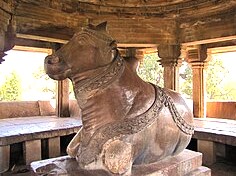
I particularly liked the monolithic, beautifully carved Nandi statue which is carved from a single piece of black stone, with its tail tucked in and in a sitting posture. It is 7.22 feet long and 5.91 feet high and was in an open square pavilion with 12 pillars facing the Vishvanath Temple, it is known for its intricate craftsmanship and serene presence
One more significant one is that of the statue of Varaha which is 9 feet tall and made out of a single piece of solid yellow sandstone and shielded by a beautiful lotus ceiling. The surface of the sculpture has 674 deities in 12 carved rows on its entire body. The sculpture also depicts goddess Saraswati with the Veena in her arms. The Varaha idol was installed by the Chandela king Yashovarman as a celebration of victory over his Pratihara ruler during AD 950.


One elephant statue we found at the entrance of a temple with the mahout lying tiredly on its back depicted maybe as if returning from a strenuous war

That evening we attended Khajuraho light and sound show at the Western Group of temples, we were all sitting on chairs in the lawn and there was a happy silence only interrupted by the chatter of small children, suddenly the sky was brightly lit with lasers and the narration started with the history of the temples, the Chandela dynasty and creation of the temples, the founding of Khajuraho, its history and the restoration and recognition of the temples by UNESCO.

The show was electrifying and took us back to good old days of grandeur and kingdoms but also wars, treasons and invasions by greedy, cruel and inhuman invaders
The show is held daily with timings changing seasonally, and ticket prices are ₹250 for Indian citizens and ₹750 for foreign nationals. The show is presented by the Madhya Pradesh Tourism Development Corporation and the Archaeological Survey of India and is a 50-minute program, first show is in English and second one in Hindi with narration by Amitabh Bachchan.
The Khajuraho week long dance festival is held every year in February/March with various classical Indian dances set against the backdrop of the Chitragupta or Vishwanath Temples in open air auditorium and is organized by the Madhya Pradesh Kala Parishad, it features renowned artists performing various classical dance forms like Kathak, Bharathanatyam, Odissi, Kuchipudi, Manipuri, Mohiniyattam and others .The festival also includes other attractions such as an open-air market for local crafts, a food festival, and various cultural excursions.


Very detailed description. Presented in a flowing prose. Well done.
ReplyDeleteVery detailed description. Presented in a flowing prose. Well done.
ReplyDeletethank you so much for the feedback
ReplyDelete