We finally reached Desert Himalaya Resort, where we would be staying for the day. We were very tired after a long drive.

Though the approach road was a little rough, the resort was tucked within 6 acres of lush green land and looked welcoming.
We had experienced staying in a tent in Amby Valley, Lonavala, but our stay was more memorable in Nubra Valley due to the solitude all around us and awesome views of the majestic Karakoram and Ladakh Range, with natural springs flowing here and there.


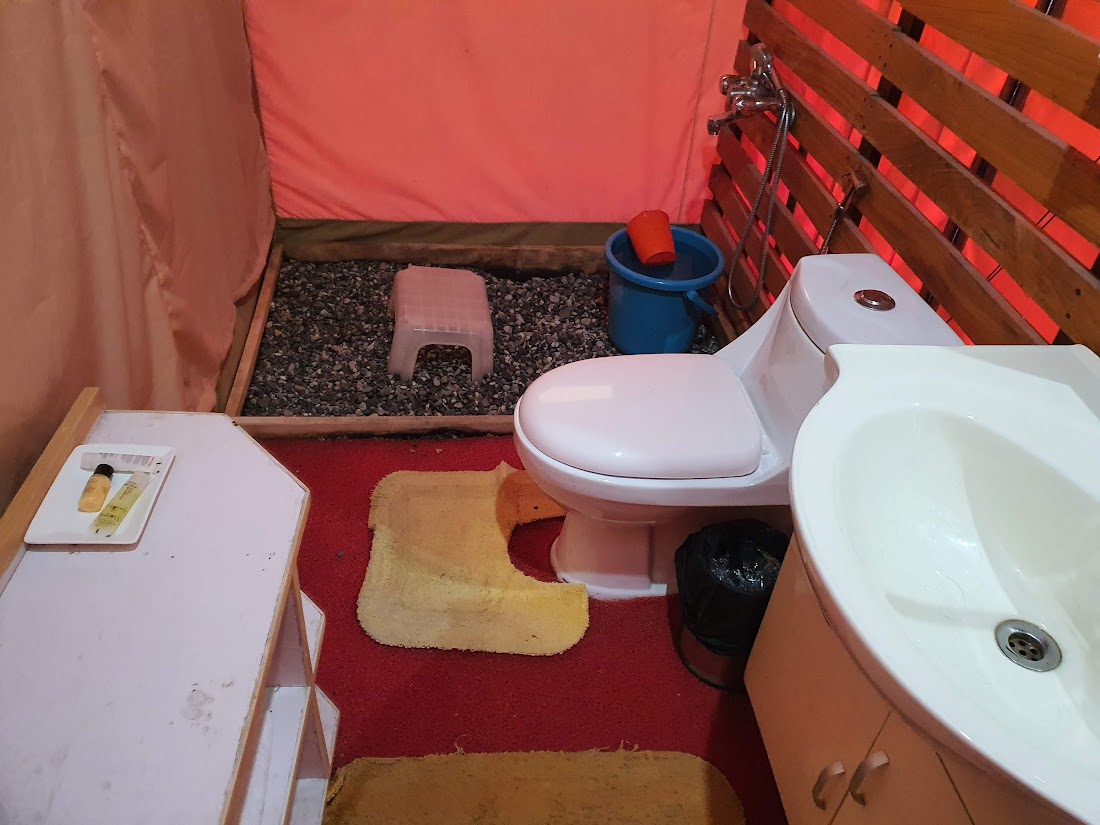
The tent was comfortable, spacious, and well equipped with amenities like a sofa, study desk, heater/cooler, tea/coffee maker, bathroom with a shower cubicle, hot/cold water, washbasin, and organic toiletries. We were promptly served hot chai in our tents on checking in.


After resting for a while, we freshened up and started for the Hunder Sand Dunes for the camel safari. I thought it was indeed a miracle of nature that sand dunes could be found in such high-altitude rocky mountains.

After a 10-minute drive, we came to the dunes and saw one of the most unique sights in the world: the double-humped camels, also called camels with a backrest. The Bactrian camels, found only in Hunder, were the main mode of transport when Ladakh was an important stopover on the ancient trade routes with Central Asia.
We stepped down from the car and walked down to the dunes; midway, we found a natural stream made accessible to tourists, where the young were jumping and the old relaxing with their feet dangling in the cool water.

There was quite a crowd; we took our tickets, and after waiting for a while, we got a chance to ride on the camels. Riding one of those is a memorable experience that brings people here from afar.

The camels bowed down on their hunches, and each of us got on them. Only one person was allowed on each camel unless it was a small child with its parent. When the camels got up with a jerk and a shrill grunt, it was quite scary but thrilling; all around were the beautiful rugged mountains, some wearing snow caps, and there were undulating white sand dunes on which some tourists could be seen walking and frolicking in blissful joy.

The rocking and wobbling movement of the camel sent me into a happy rhythm, and I was rudely disturbed by a tiny camel running behind mine. My camel appeared to look back accusingly at me. The person who was leading our pack of camels said with a cheeky grin that maybe the small camel wanted a cuddle from its mother, which was the camel I was riding on.

My husband remarked in mirth that only humble me seems to go through such experiences; we were reminded of my rebellious horse in Bhutan, which was hell-bent on throwing me off its back from the top of the steep Tiger Hill, but that is an entirely different story
All in all, it was a thrilling experience to ride on the double-humped, camels though it was heart-wrenching to see the camels giving rides to an innumerable number of tourists with no rest whatsoever because the owners wanted to finish the rides before the sun set.
Hunder sand dunes had quad biking facilities, and in between the hills there were zip lines too, though we were too tired to use them.

It was getting dark, the sun was setting and the weather became cooler. We returned back to our resort and had our dinner in the restaurant. It was a buffet with an average menu, but the live singing made our meal worthwhile. I always wonder why even average singers sound so melodious when they sing in the restaurants or on cruises; maybe their choice of songs suits our holiday mood.
We then sat on our verandah and gazed at the beautiful surrounding mountain range. The trees waved their boughs at us gently; the view of the night sky was especially amazing with millions of sparkling stars and the moon peeking amongst them. Don’t we have these views in our cities, or do we not have time to sit still and watch nature? I loudly pondered.

Hunder Valley is extremely beautiful, and the festival of Hunder is a chance to see the ancient culture of local people. It is celebrated jointly with Diskit Monastery every year. The display of Cham dance and traditional arts and sports is the highlight of the festival.
Winter is quite harsh, and Ladakh remains snowbound during the season. Visiting is possible only during summer, from June to August, which is the best time to visit Hundur, which is like an oasis in the midst of the harsh rocky setting.
We had to start early for the Pangong River journey, so we got our breakfast packed with rotis, sandwiches and fresh fruits.

We first travelled all the way back to Khalsar Village, where the road split, and we followed the road leading to Village Agham. For most part of our drive, we were accompanied by the Shyok River. The road was quite smooth till we reached Durbuk village, where we stopped for a cup of tea.

The restaurant was quite small, but its charm was the tall, threatening hills on one side, which looked as if they would topple any moment on us and a brook on the other side. We continued till we reached Tangtse.


The road was in places nonexistent, and the constantly flowing icy water flowing down the hills seemed to destroy the roads, which were filled with slush and stones. I noticed that the 2-wheelers were having a tough time navigating these roads.


Rocked in the car like the pebbles on the road, we didn’t notice the approaching Pangong Lake till our driver pointed it out to us; it was shining in the bright sun like a beacon light urging us to reach it faster.


Pangong Lake, or Tso, lies at a breathtaking elevation of 14,270 feet. Interestingly, the lake is around 160 km long and can be seen on maps between India and China; 60% of the lake stretches in China, which is an exciting thought for a tourist.

The surreal clean blue waters are actually brackish or salty in nature, and no aquatic life survives in the same; the temperature range between -30 and -10 degrees makes even this salty lake freeze with thick ice sheets.

We reached the lake and walked down to the shore; indeed the lake was worth coming all this tough way. Its colours were to be seen with our own eyes to be appreciated: blue water with sudden changes of color to green when the sun aimed its rays on it and grey when the clouds threatened to cover it; the lake seemed to act like a chameleon.


The tourists can click snaps with them for a small fee; we took a few snaps, and my hubby joined me after a lot of coaxing.


Apart from 3 Idiots, Sanam Re, Dil Se, Jab Tak Hai Jaan, Waqt, Tashan, and Heroes were all shot in this locale. Mostly, campsites, cottages, and small guest houses support the stay of tourists and I thought it would be divine to wake up to the sight of the beautiful lake, but alas, we had to proceed to Leh!

From January to February, the lake becomes frozen and forms a perfect setting to play cricket or enjoy the chit-chat while walking over the surface; it is like another ‘chadar’ famous for the name of the frozen Zanskar River trek.
After the visit to the lake, with its sweet memories stored in our minds and hearts full of peace and harmony, we took a different route this time to Leh via Lukung, Tangste, and Darbuk. On the way we saw the Chang La Pass, the third-highest motorable road in the world at an altitude of 17,590 feet. We had a roadblock there but it was very quickly cleared.

Chang La Pass is closely connected to Leh via the Kharu and Shyok valleys by a tricky asphalt road, which is the major gateway to the famous Changthang Plateau in the Himalayas.

The name Chang La means "a pass to the south," and its name is related to Chang La Baba, whose name there is a temple for.

Tangste, a small town existing near the pass, is the only inhabited region in the vicinity.
Finally, we reached Leh and were given our original room, where we rested and got ready for the flight back home.
Looking back at our Ladakh trip, we started on an apprehensive note, wondering whether we would be able to withstand the low oxygen in the air but with God’s grace, we managed and enjoyed the trip. There were anxious moments when we wondered if we could climb up to a particular monastery or hill, but we could do it and enjoyed the nature,the people, and the places. Ladakh will certainly hold a special place in our hearts from now on for sure.


