We had reached Jomsom in Nepal, left our luggage in our room, freshened up, and started for the Muktinath temple by jeep. The road we would be taking would not be suitable to travel in cars.

Muktinath is one of the most sacred and significant pilgrimage tours in the world for Hindus and Buddhists. It is located in the Mustang district at the base of Thorong La mountain pass at an altitude of 12,500 feet, is one of the 108 Divya Desams, is only one located outside India, and is also one of the Char Dham in Nepal .

Considered sacred by the Sri Vaishnava sect, in Sri Vaishnava literature it is named Tiru Shaligramam; Buddhists call it Chumig Gyatsa, a Tibetan meaning "Hundred Waters." For Tibetan Buddhists the holy murthi is a manifestation of Avalokitesvara, who embodies the compassion of all Buddhas.
There is a legend dating back to the 12th century that Guru Rinpoche, also known as Padmasambhava, the founder of Tibetan Buddhism, meditated at Muktinath on his way to Tibet.
Hindu mythology refers to a battle between Lord Shiva and Jalandhar, a powerful demon king who had a pious wife, Vrinda. During the war between Shiva and Jalandhar, the demon king was killed, and his wife cursed Lord Vishnu, who had helped Shiva in killing the demon, to turn into a Shila and this is how Muktinath originated and Lord Vishnu started getting worshipped there.
Devotees coming to the Muktinath temple also worship a 400 million-year-old Shaligram originally found in the Krishna-Gandaki river and now placed in the temple; the 96 square miles surrounding Muktinath is referred to as Shaligram Kshetra.
The other famous legend relates to the death of Sati. It is believed that her face (Mukh in Sanskrit) had fallen down here, and so this place is honoured as Muktinath.
Best time to visit this temple, due to the extreme weather conditions prevailing locally, is September, October, and November. During the festivals of Rishi Tarpan, Ram Navami and Vijay Dasami, thousands of pilgrims arrive for the darshan of Lord Vishnu.
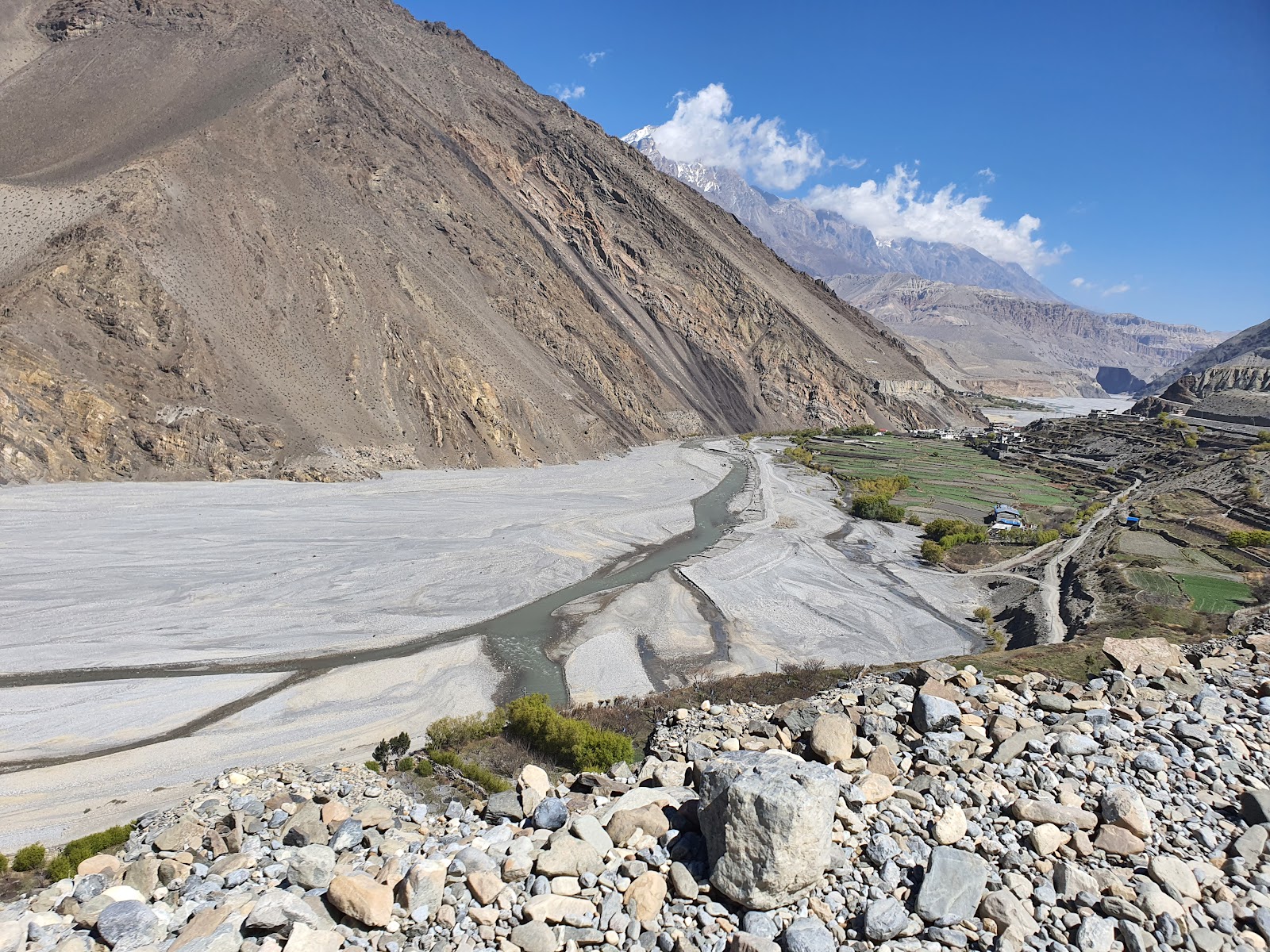
As we sped on our way, we saw that the river Gandaki seemed to accompany us. This river has the uniqueness of having in its riverbed and banks a kind of stone called shaligram, fossils of ammonite shells that are associated with Lord Vishnu and resemble Shankha (conch shell), a sacred emblem of Lord Vishnu used by people as a trumpet during Hindu rituals and festivals. Many travelers come to Mustang from different part of the world just to get a Shaligram stone.
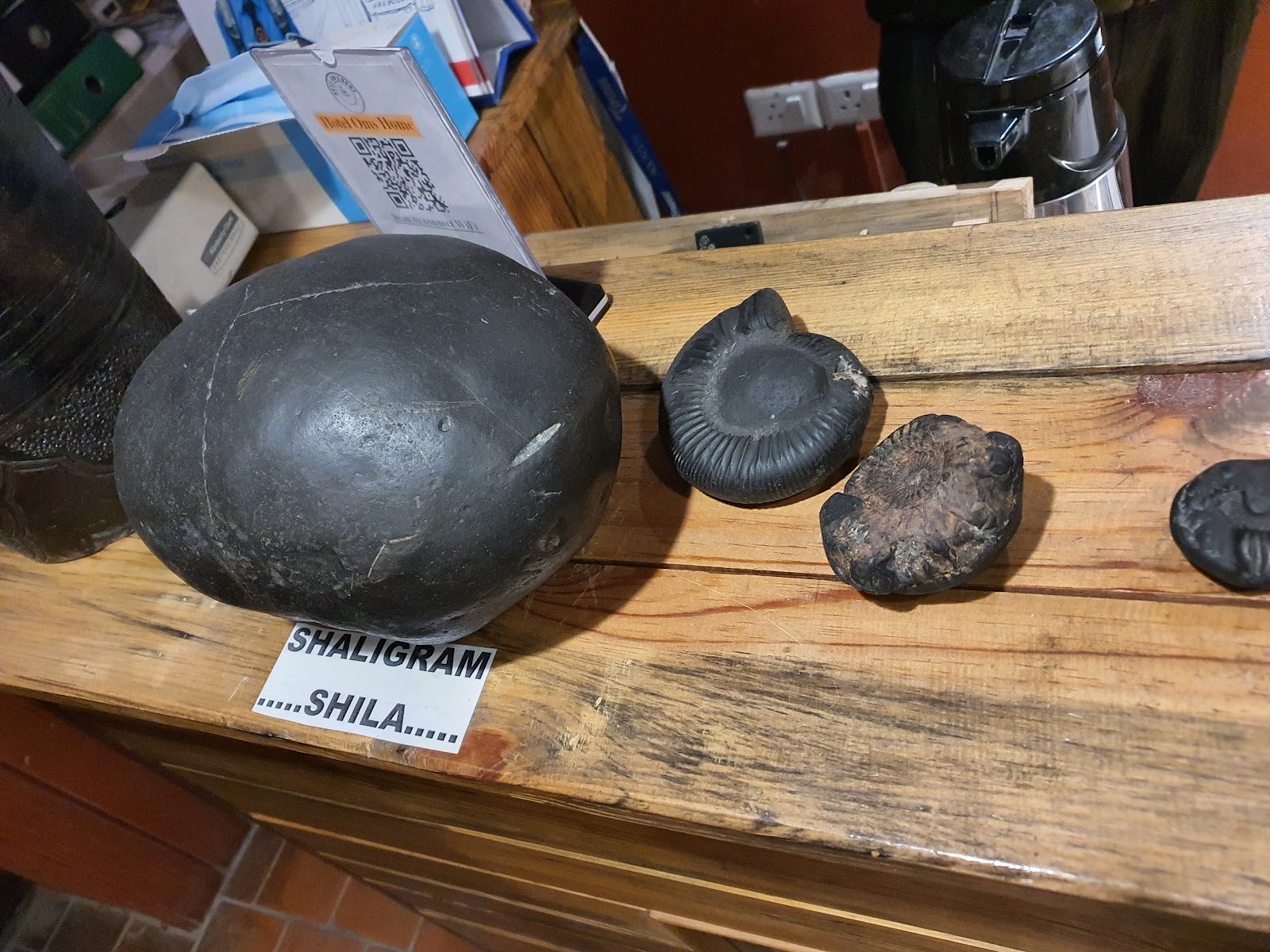
The different patterns of the stone are worshipped as different forms of Vishnu; white color is considered Vasudeva, black as Vishnu, green as Narayana, blue as Krishna, and golden yellow & reddish yellow as Narasimha and Vamana in yellow. The stones are found in various shapes with the shapes of the Panchajanya and Sudarshana Chakra, which are attributed to Vishnu. They are freely found along the banks of the River Gandaki and also sold in the shops in Nepal.

As the way was picturesque, though the road was bad, we enjoyed the travel to the village of Ranipauwa. It was only 24 km but took us 1 hour. On the way we met many trekkers, both young and old, patiently walking along the roads. I was sure they were finding the constant stream of vehicles, their horns and dust a big unavoidable nuisance.

We got down at Ranipauwa and looked around us; we saw the mighty mountains Dhaulagiri and Nilgiri towering over us from all sides. The streets were bustling with tourists, and the locals were busy with their daily routine.


We had inquired and were told that we could take horses till the temple for a sum of 300 rupees, or we could walk for a short distance and climb 250 steps. We discussed and decided to use our feet.

It was very cold and breezy; as we walked up the incline, the cold air and the high altitude made us slow down, as it was difficult to breathe. People are advised to carry camphor or ginger to overcome the low oxygen conditions.

There were small stalls selling beads and shaligram stones, few Nepali women were weaving Nepali shawls on very basic looms; some youngsters zoomed past us in motorcycles, which were allowed till a certain point.


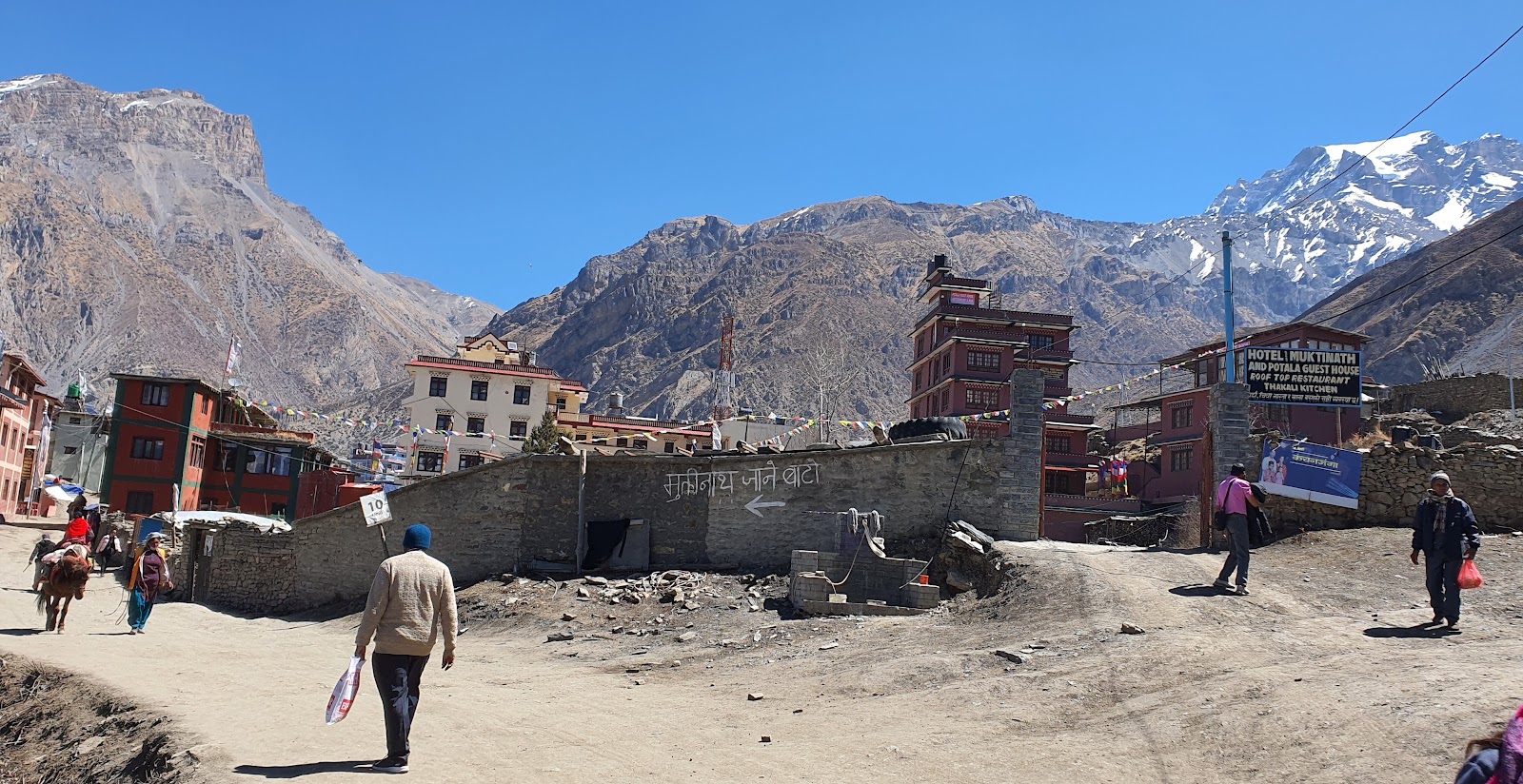
Finally we reached the welcome arch of the Muktinath temple, and the temple regally stood on top of the steps, beckoning us to climb faster. Some tourists passed by us on horses, and for a second I regretted my decision not to take horses but started to ascend the steps, sure of getting a lot of mukthi.

I observed some tourists being carried on doli shaped like stretchers and admired their devotion and also appreciated the hard work of the locals carrying them up the steps.
Now we started our holy trial. Walking up the stairs was really tiring; the high altitude didn’t help us at all, the winds cheekily egged us on and we could see that tourists were going up a few steps and then stopping for a breath.

To one side sat the holy Sadhus, most of whom were from India, and talking in Telugu quite fluently, some of the tourists returning from the temple were taking blessings from them and offering Nepali rupees in return.


We almost reached the temple and saw a Gompa and small temples on the way.
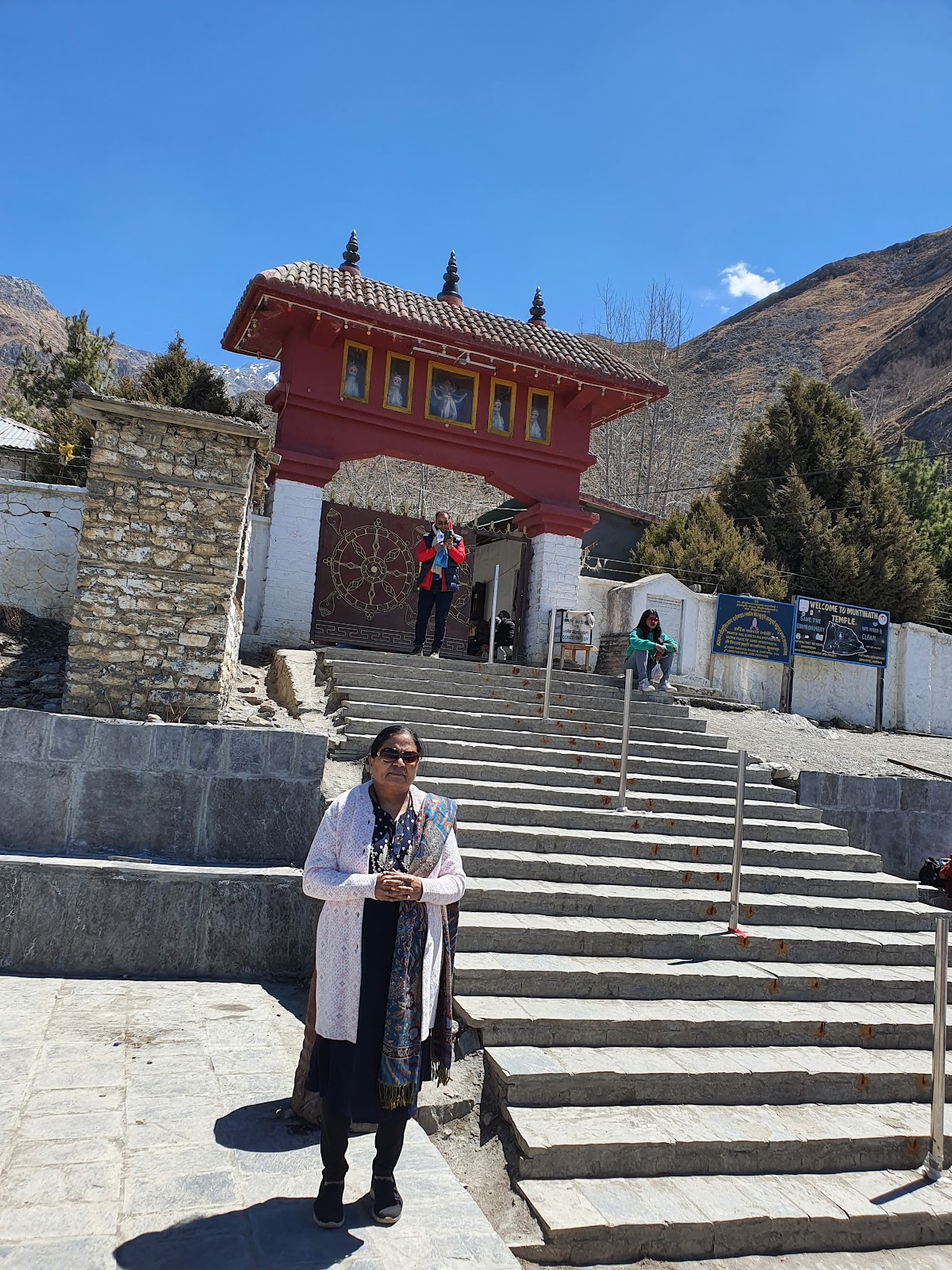

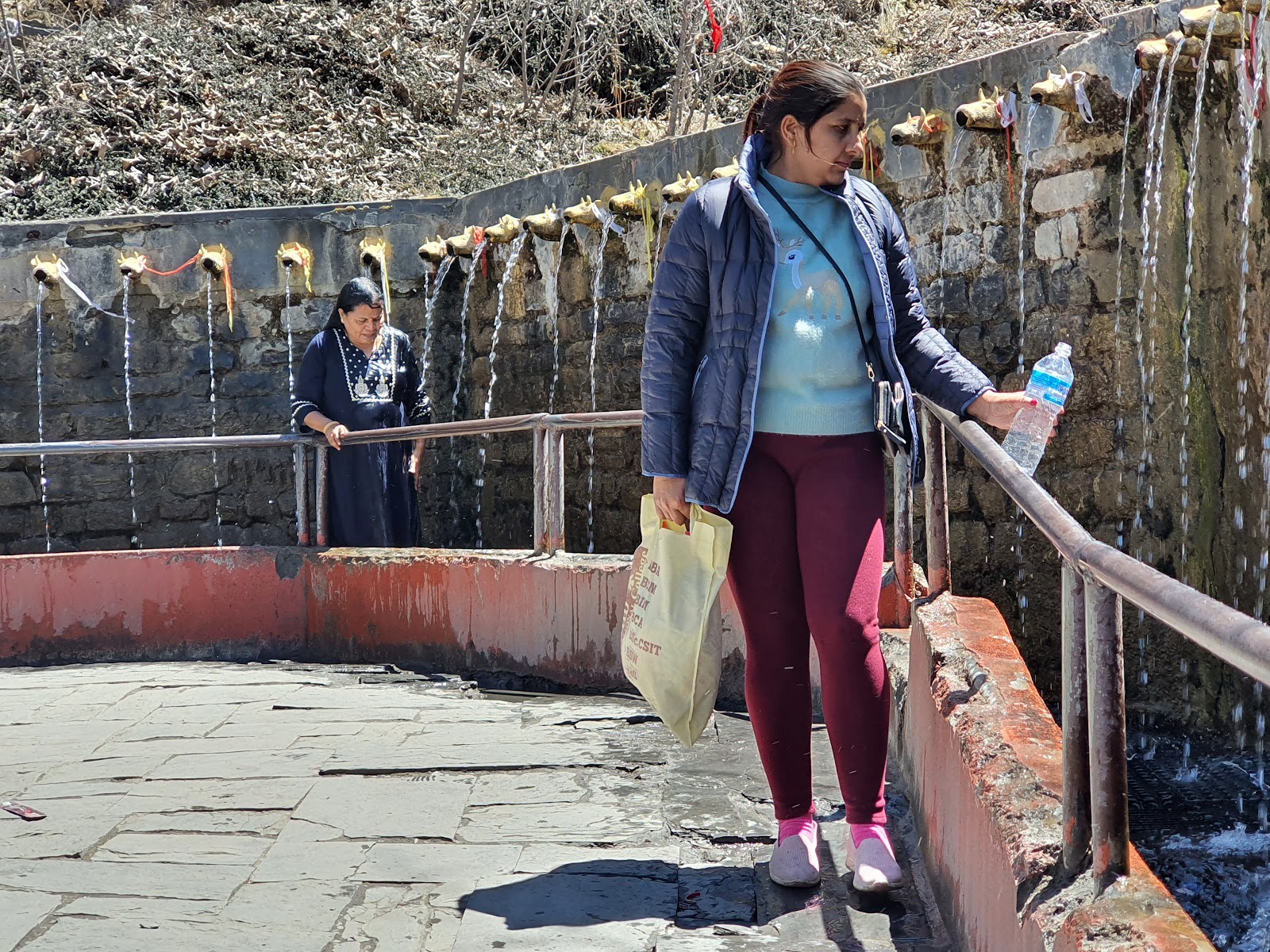
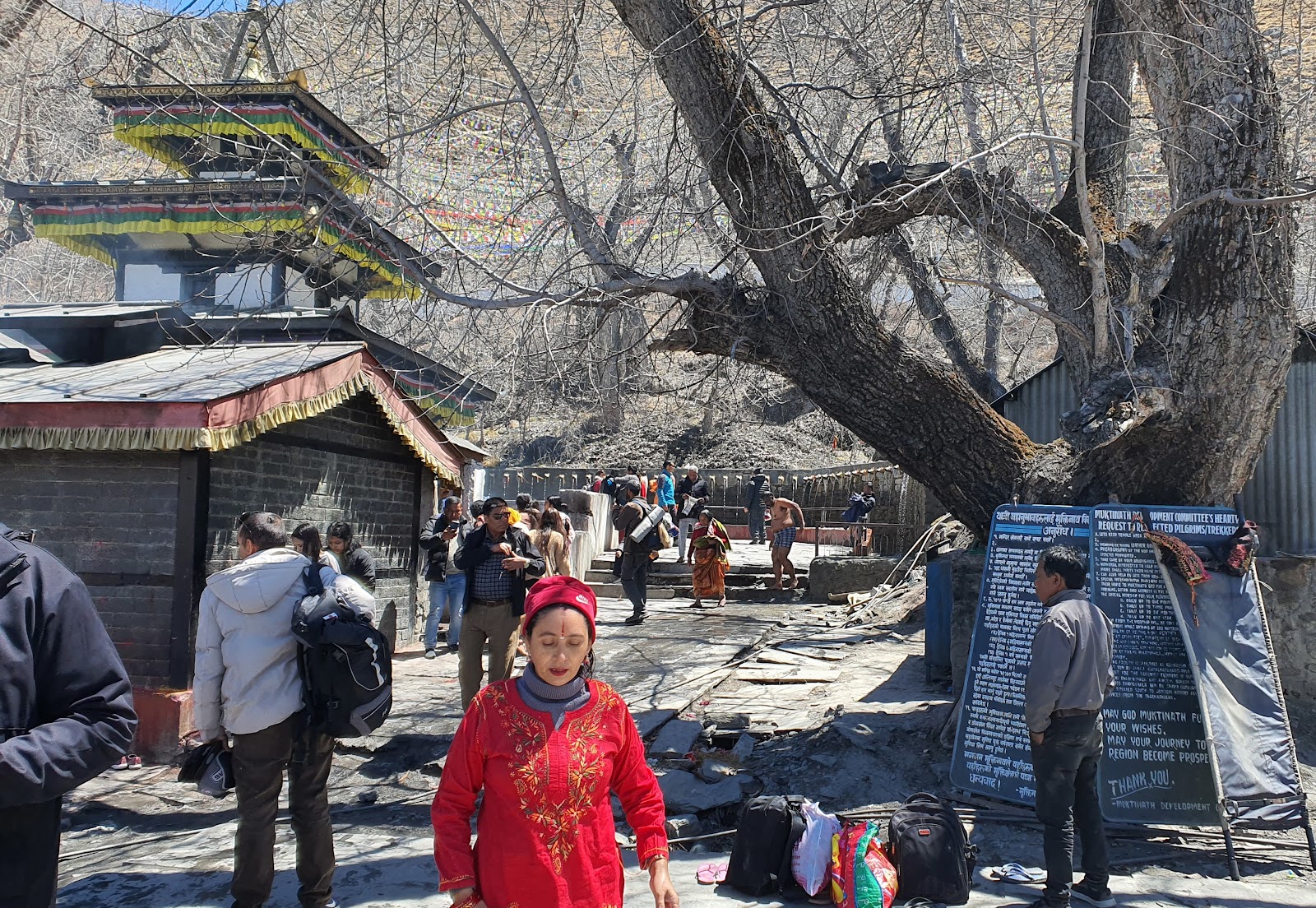
The prakaram (outer courtyard) was huge, and the temple was simple and 3 tiered, behind the temple flowed Muktidhara—the source of the river Gandaki. There were 108 water spouts in the shape of a bull’s head through which the natural spring water poured. The sacred water that flows in these 108 spouts denotes the sacred Pushkarini water from the 108 Sri Vaishnava Divya Desams; we saw the tourists taking baths or collecting water in bottles to pour over their heads.

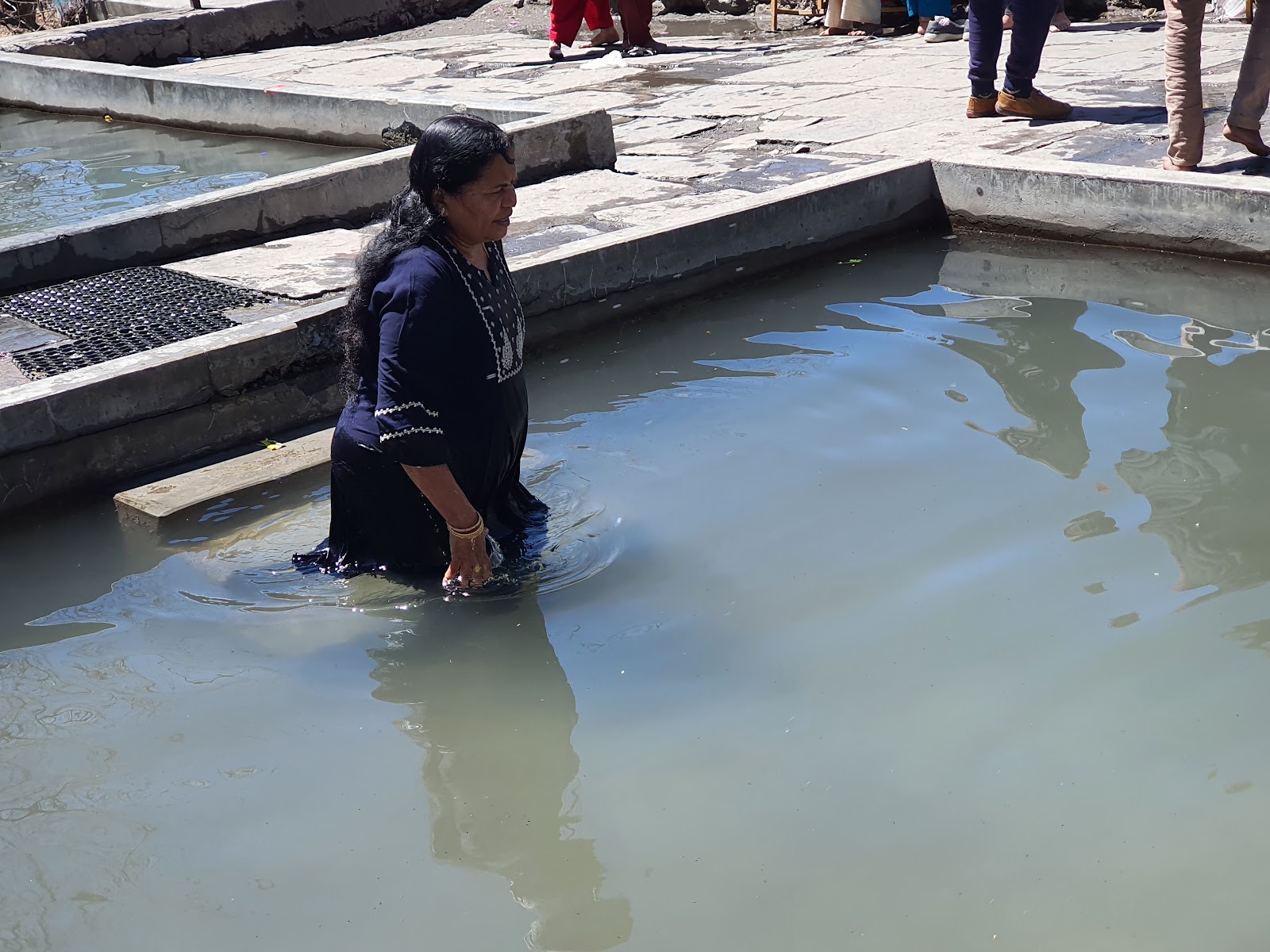
Water from these spouts collected in two ponds called Saraswathi and Lakshmi Kund and pap and punya kunds, bathing in this pond is considered very sacred and is believed to hold the power to wash away negative karma and the results of one’s past negative actions.

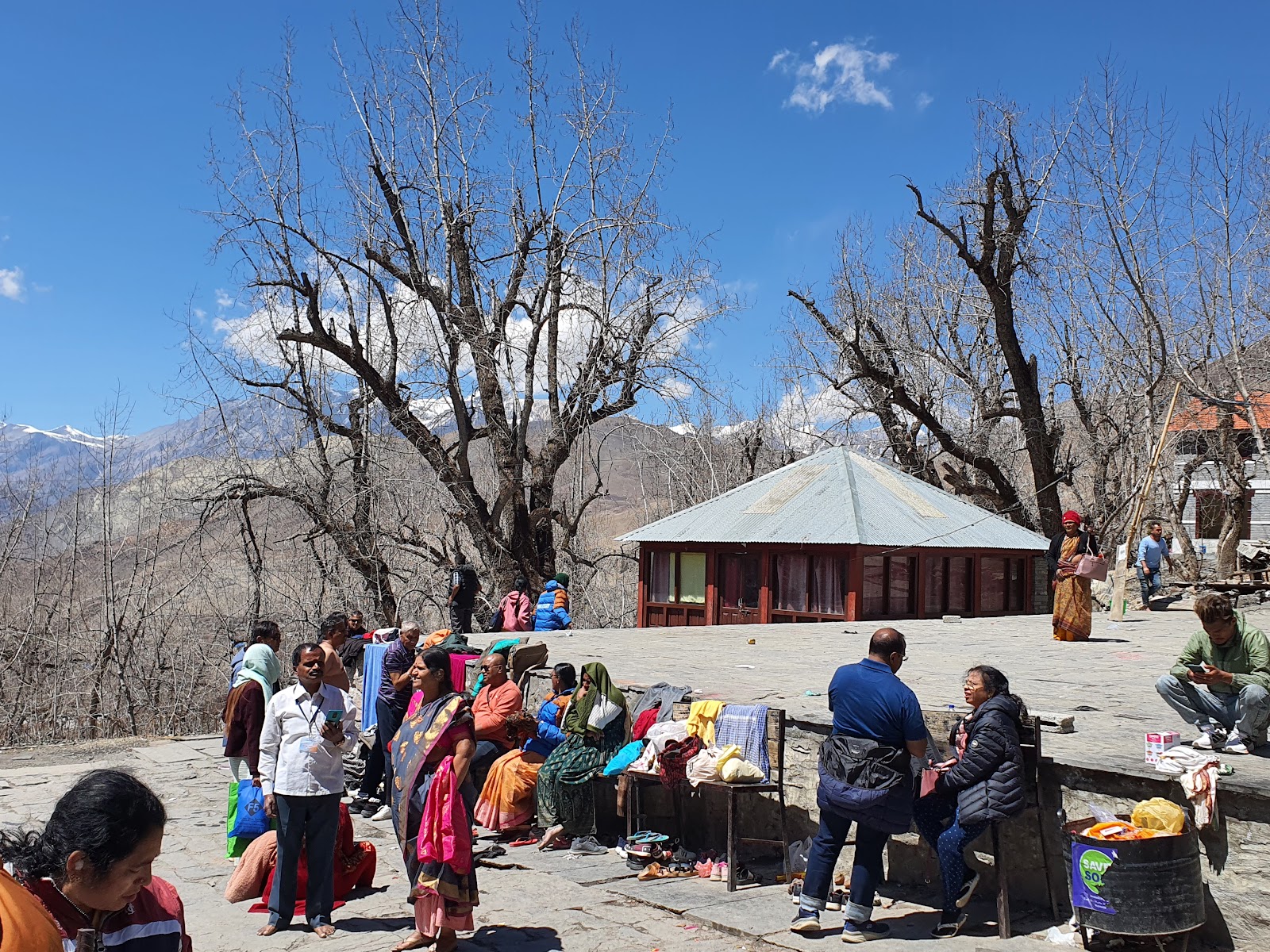
We placed our bags on a bench and took turns having a bath and dipping into the kundas.
Once my husband finished his holy dip and changed into his conventional attire, I started my walk under the 108 waterfalls. I braced to put myself under the icy water; I should say only utmost devotion and grit allow us to go through the ice-cold water. I came out and dipped into the 2 kunds; by now I was freezing and my teeth were chattering with the cold , I rushed to the changing room, where I thankfully changed into dry clothes.


We later waited in the queue and entered into the temple. The main deity is Vishnu, made of pancha loha, some say it is gold, is very lifelike and is in a sitting posture with four hands gracing the devotees by its supreme tranquility .

(This picture is courtesy of the internet, as cameras are not allowed inside the temple.)
There are other idols of Lord Shiva and Goddess Parvati, Bhoodevi , Sita, Luv and Kush, Garuda, and Sapt rishis in the temple. It is said that the initiative for the construction of this temple was given by Sabarna Prabha, a Nepali queen.
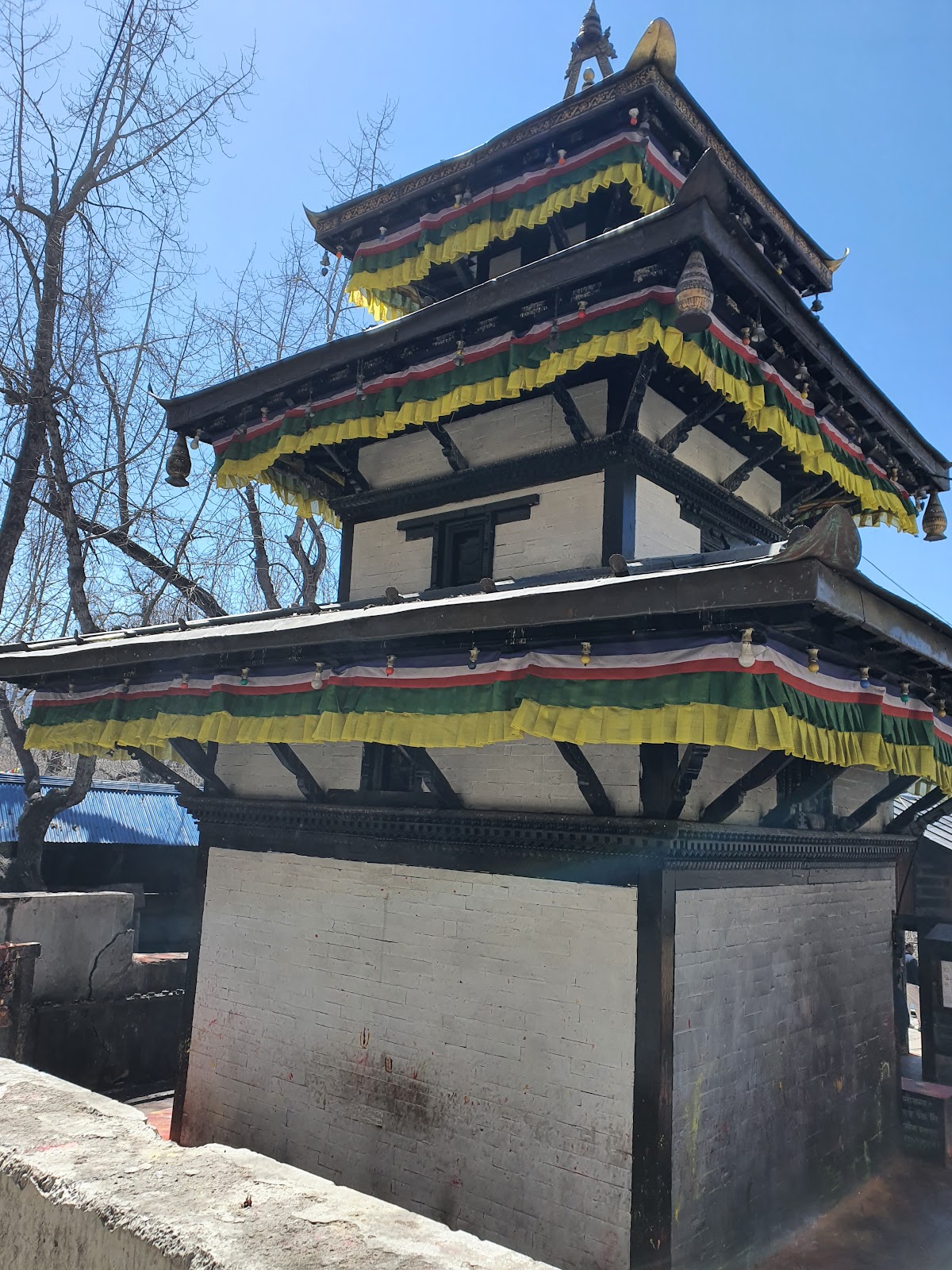
The temple had an aura beyond words. We could light diyas, were given holy rice grains to take home , we prayed and came out.

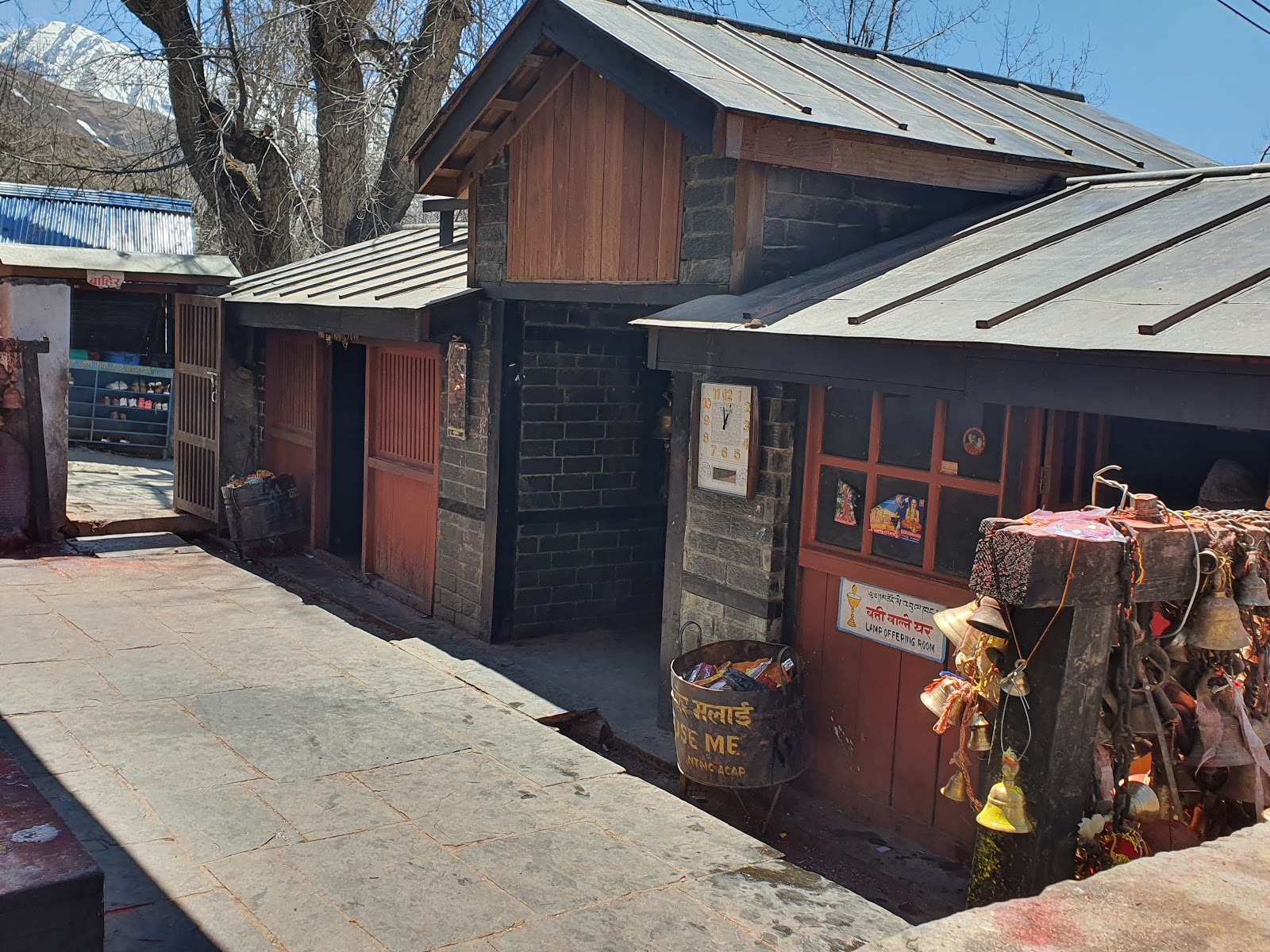
There were a lot of Indian tourists, mainly South Indians; we could see many Nepalis and few foreign tourists, probably on their way to and from the Annapurna Circuit trekking.
We then went to see the 35-foot stone Buddha statue, which was nearby and built at a cost of 5 crores; the weight of the idol is about 60,000 kg, and it is the biggest 'Stone Statue of Buddha' in Nepal.
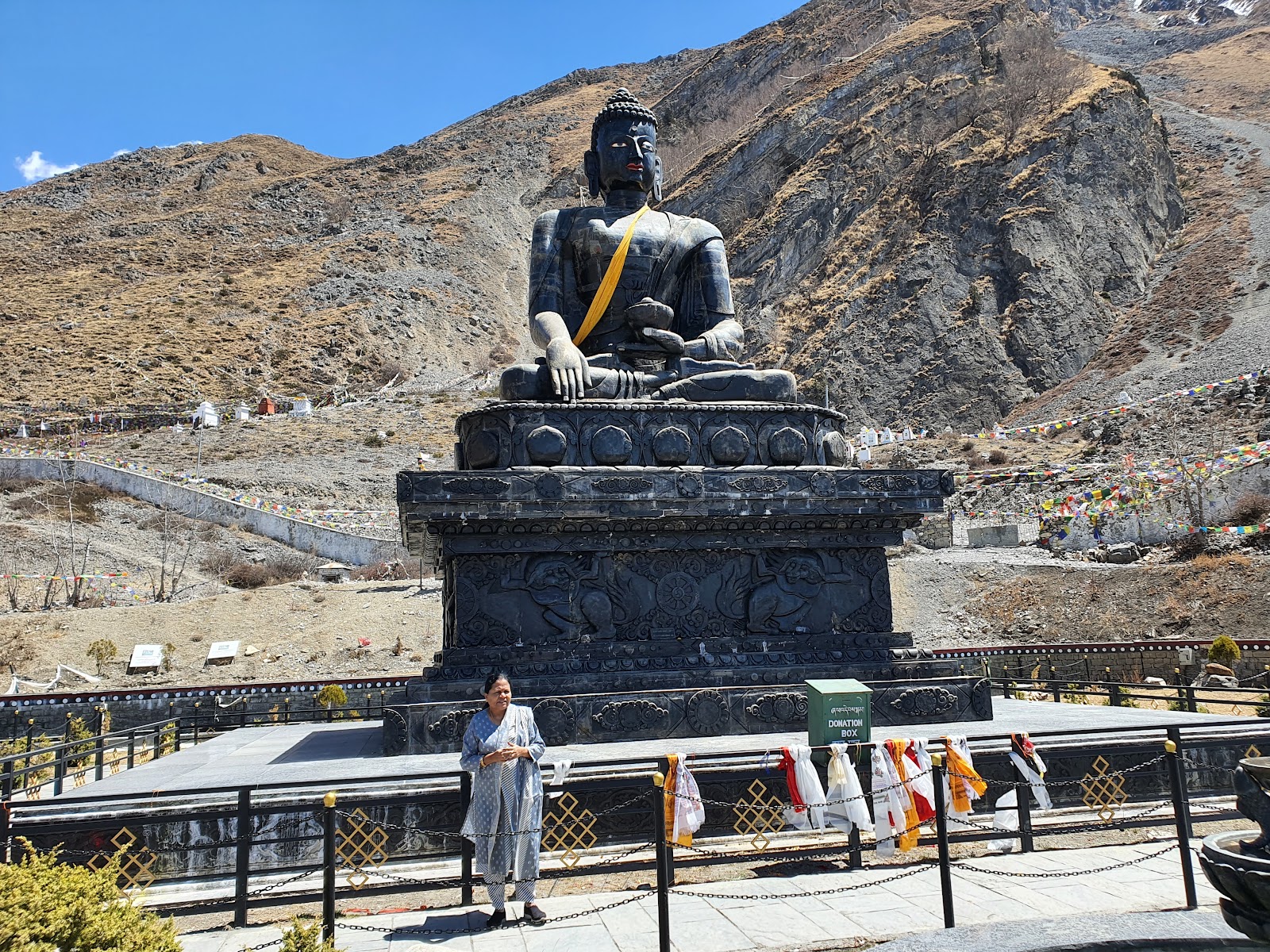
It was enthralling to sit there peacefully and watch the snow-covered Annapurna range to the south and the Tibetan Plateau to the north. Buddha was highlighted against these mountains in the stark background, only harsh disturbance was the video conversations some of the tourists were having with their near and dear back home. I always wonder why we Indians talk so loudly on the phone.

We then went to the Jwala Mai Temple, the temple of the eternal flame, located inside the Tibetan-style Dhola Mebar Gompa, to the east of the main Muktinath temple.

It is built above an underground water stream, and small natural gas jets underneath the gompa produce continuously burning flames on top of the water. This supernatural flame is supposed to be a result of a penance performed by Lord Brahma, who invoked fire on water.
The holy flame alongside a spring, in combination with earth, water, fire, and air, seems to be the origin of the religious significance of Muktinath, because only here are all the elements present in one spot.
The small burning flames are hidden in the Gompa on the floor, behind a grid. We had to kneel almost to ground level to see the small blue flame (behind a grid) said to be burning here for thousands of years.


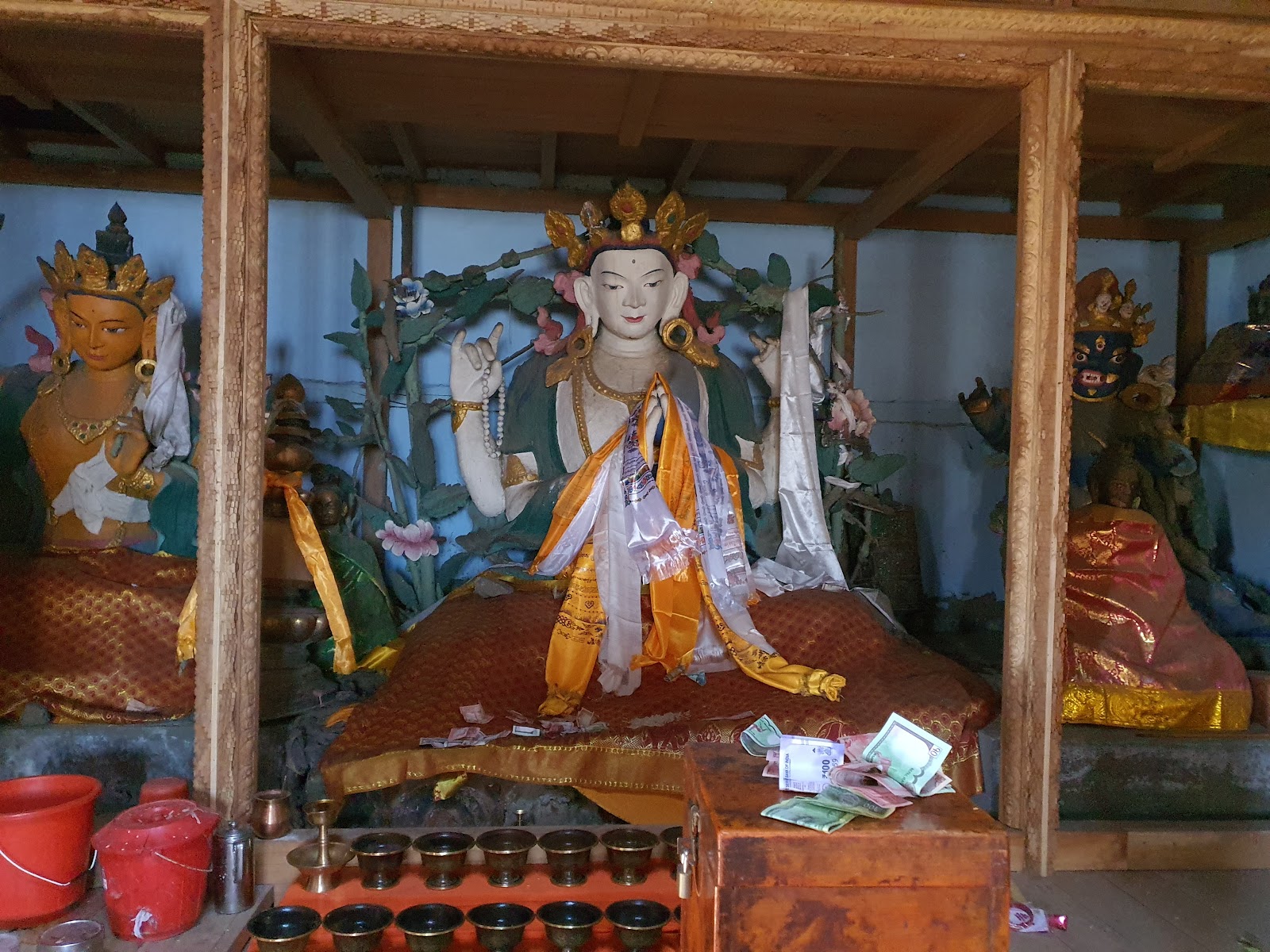
Inside the Dhola Mebar Gompa, huge statues of Manjushri, Avalokiteshvara, and Vajrapani could be seen. But I felt that the atmosphere was more like any Buddhist temple than a Hindu one. To our surprise, not many tourists were aware of this temple, where pooja is conducted by Buddhists.
The spring water from inside the Jwala Mai temple rushed outside through a bull-shaped water spout.

We came down the steps, which was much easier than going up the steps. It was almost lunchtime and we went into a small café in the village, which had many hotels and restaurants too, and ordered some simple fare. One has to take care about the chilli and spice used here; we ordered medium spice and regretted it as I had tears abundantly running down my cheeks.
Later we tried to shop for Shaligram; we didn’t have any expertise about them and had to trust the local sellers. Shawls were cheap ,I bought one, though I was sure they were not pure Pashmina at that cost. I loved the cheerful girl looking after the shop.

We have gone on a lot of pilgrimages but Muktinath temple trip was entirely a different experience, it was totally humbling and rewarding and left an everlasting impression in our minds.


No comments:
Post a Comment