Sunday, 2 July 2023

OM NAMAH SHIVA ! OUR NEPAL JOURNEY

We checked into Fish Tail Lodge our resort in Pokhara and quickly freshened up and started our day tour.

We wanted to go to Sarangkot, a 5860-foot-tall hill situated on the western side of Pokhara and known for its panoramic Himalayan views of Dhaulagiri, Annapurna, and Manaslu.

The hike up from Pokhara Baglung Highway at Miruwa to Sarangkot normally takes 90 minutes to 1.5 hours and is a scenic one, but we didn’t risk it, we went in our car to the Annapurna cable car station at Seti Nagar for a cable car ride to Sarangkot. 

Before dropping us off, our driver told us to ring him before starting our return cable car journey so that he would come and pick us up at Seti Nagar station.

The cost of a round trip ticket on the Annapurna Cable Car was NPR 800, and for Nepalis, NPR 700.

Luckily for us, there wasn’t much rush, as the tourists go there mostly at sunrise or sunset to see the awesome views from the view tower at the top.

A motor car ride, which would take 40 minutes up the undulating roads, would now take us only 9 to 10 minutes by the cable car.

We took the tickets and waited for our turn. A young female solo traveller was with us, and I asked her from which country she was coming. She said Ukraine, I wondered at this time of active war how the citizens were traveling but didn’t voice it aloud, paying heed to my husband’s meaningful glances, the person monitoring the cars was an Indian from Kerala and had worked in the Indian army till his retirement.

As we went up smoothly, we could get an excellent view of the entire Pokhara city, including the Phewa lake .

Down below us, as we were passing by, we could get glimpses of peaceful, relaxed village life with quaint little houses and animals, mostly goats. Most of the houses had flowerpots on their terraces and front yards, flowerpots brimming with lovely flowers and colorful clothes drying on clotheslines and fluttering in the wind.

Some of the houses were homestays as evidenced by the welcoming boards; we came across many tourists trekking up the hill.

We could see cars and an occasional bus going laboriously up the winding serpentine roads.

We arrived at the alighting point and walked down to the viewpoint. There was an elevator that led to a view tower, which had the most divine views from the top and offered freshly brewed coffee for the tourists for sale.

One of the largest mountain ranges in the world, the Annapurna range, and Annapurna, the 10th highest mountain in the world, were visible from the view tower.

I wondered if man can ever surpass nature in any aspect; the tall, proud, mighty mountains glittering in the bright sun took my breath away and filled my heart with peace and humility.

There was a small Shiva temple at the top that acts as the hub of celebration on important festival days, To pray, I respectfully removed my sun hat, which I had been carrying around the world for the past 10 years and placed it on a ledge there. I forgot to retrieve it and missed it only after coming down alas, I thought maybe it was fed up with me!

There were a lot of activities going on at Sarangkot; we could climb up a path and do wildlife viewing, but we were told that occasionally a tiger or leopard is known to stroll across, probably to see the beautiful sunrise or sunset, so we didn’t want to be delicious kababs for them. Those interested could also do top-notch bird watching. 

Sarangkot is the launching point for one of the longest and fastest ziplines in the world that starts at the top of the mountain and runs down to the valley below.

We could see the tandem swing offering a 45-foot fall and lasting for 4 to 5 minutes; there were young tourists trying it, and I enjoyed the excitement on their faces because it was like they were flying directly into the sky.

There was a sky cycling spot with the cycling rope suspended above the ground, and people were cycling on it with gay abandon with no fear of falling.

My husband was, meanwhile, trying desperately to reach our driver, who wasn’t lifting the phone. I muttered to myself, lo! Here start our troubles again, however, this time we had taken the main agent’s number too. After hectic calls to him, he finally answered and told us that he had given the wrong phone number and that the driver would come and pick us shortly.

After this fiasco we wanted to have lunch and were taken to a small restaurant where there were loads of Indian tourists all eating dhal chawal. The hotel owner gave some free gyan to us as to why Indians want to eat only Indian food and not try the local cuisine; we had no answer, we smiled and went out after eating a masala dosa each.

Our driver stopped at a parking lot and asked us to go the Devis Falls and also the Cave, which was just adjacent to it.

Particularly in Nepal, I have seen the tour agents send their customers without giving any information about what to see and do, so one needs to do a lot of research before going to these places. 

We walked down to the Gupteswar Mahadev cave, whose entrance was almost hidden by the stalls selling religious items and souvenirs, 

We did a little shopping mainly for our little grandson staying in US; we could get a typical Nepali dress and some beads. The shop owner was a lady who also came from India and had worked in the Army.

The cave, which is 100 feet deep and 6750 feet long, was allegedly discovered in the 16th century by some local men who stumbled upon it accidentally. Within the dark cave, they discovered many shrines and statues dedicated to Shiva and other Hindu deities. 

There was an entrance ticket of 100 Nepali rupees, and when we went further, there was a spiral staircase adorned with statues depicting Hindu mythological figures.


We went down this staircase and saw an entrance gate with carvings saying "cow shed cave entry." Some people panting and drenched with sweat were coming out of the cave. 

Seeing them, I had second thoughts about going in, but having come so far decided to brave it, the minute we entered, we discovered, to our dismay that it was almost pitch dark there and we had not taken any torches with us.

The incoming and outgoing paths were blending and we were totally boxed in on either side by the mountain. There were many narrow tunnels, in areas of very low height, which needed us to stoop down, and water was dripping from the roof, making the steps extremely slippery.

As we had to remove our shoes at the entrance, it was all the more scary. I had vivid thoughts of falling and getting hurt or sustaining a fracture and clutched the support rods for my dear life. Seeing my scared face, few people who were returning from inside told me it was not very long, and I could do it. 

I wouldn’t advise a visit to this cave, for elderly people and those who have claustrophobia.

I heard someone commenting that the Cave reminded him of the Movie "Journey to the Centre of the Earth". 

After cautiously going down in the dark, we could see the naturally formed stalagmite Shivling. Photography was prohibited, though there were people taking snaps in total disregard for the rules. We were told that during the rainy season, the water from the falls would rise up to the linga and do abhishek to it. During those days, tourists are prohibited from going further down to the falls.

At the end of the cave, as we walked or rather stumbled blindly, there was a slit of bright light in the rock that showed the bottom half of Davis Falls. We could clearly hear the water roaring, the path here was very uneven and we could see the ground crumbling in a few places.

By the time we came out, we were also wet with sweat and the water from overhead; our legs were protesting at the unaccustomed exercise, and we sat for some time resting, presumably appearing to look at the statues around us. 

We walked to the opposite end of the road to see the Patale Chhango, or Devi’s Falls, David’s Falls, Devin Falls and Devis Falls, an area known for its beauty and tranquillity and the drama involved.

The water that feeds the Devis Falls comes from the Fewa Lake, starting as a rocky stream that rushes down to the waterfall. The water ultimately disappears after a hide-and-seek for 5 long kilometres.

There are many stories behind these falls which add a mysterious beauty, one of the versions is that of a trekker or hiker by the name of Devis who was swept away suddenly by the water and carried down into the underground passages and caves that run below the waterfall.

The other legend is that of Mrs. Devis, a Swiss tourist, who was swimming in the Fewa Lake in July 1961, and when the dam unexpectedly started to overflow, she was swept down the waterfall, so in her memory, the falls have been called Devis Falls, which gradually changed to Devi’ falls.

We entered through the gate and were anxious as to how far we had to climb down to see the falls, luckily, they were quite near.


There was a park with few statues but it needed to be spruced up, the path to the falls was overgrown with wild plants and ground strewn with plastic bottles and rubbish, the falls was worth seeing and in rainy season would be spectacular .


Seeing the rocky mountains around the falls, I wondered how foolish people can be, to swim in such dangerous spots, my husband reminded me that this is an adventure for some.            


There was a small wish pool where we had to wish and put in coins to see whether they would hit the exact spot; some enthusiastic, brave people had even put some rupee notes in, and a few stalls with native Nepalese attire for hire were available.

By the time we went to our car, we found that the driver had brought his little son from his house, which was in the near vicinity. 

Our next visit was to the second tallest Shiva statue in Nepal , after Kailashnath Mahadev Statue in Pumdikot, a hill station in Kaski District of Gandaki Province with a viewpoint at an altitude of 4920 feet above sea level .


We had a few moments of anxiety with the car slipping backward due to sand on the road which was very rough .

As we got out of the car and walked up the cement road, we had picturesque views of Annapurna Himalayan Range, Machhapuchre, Dhaulagiri, Manaslu and many other neighbouring mountains with the Fewa lake and valleys.

High above us towered Lord Shiva in a sitting posture, the statue was 51 feet tall, sitting on a stupa 57 feet in height.

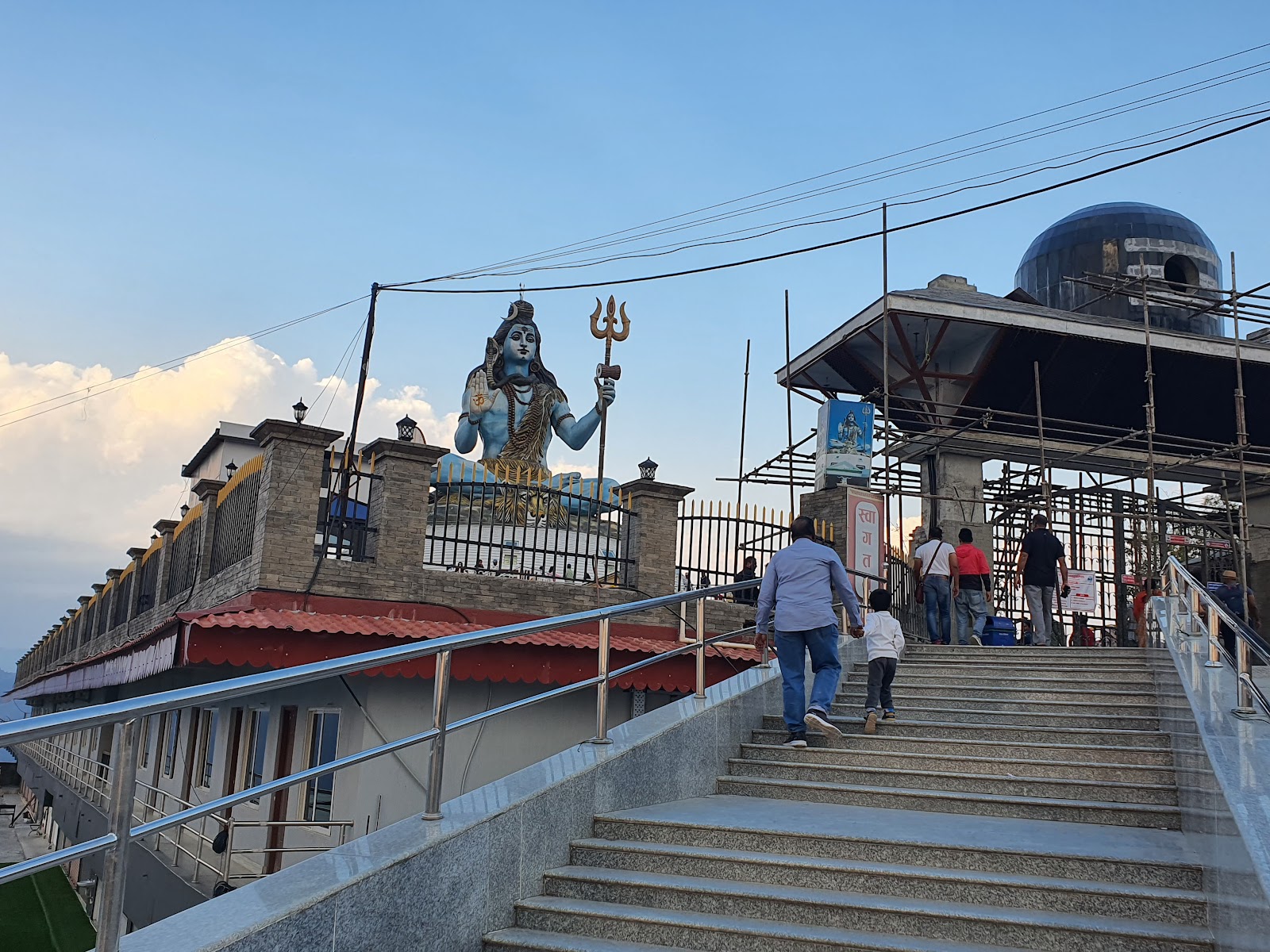
Slowly we ascended the steps, we could see a lot of construction activity going on. There are plans to construct Martyr’s Memorial Park; a model of Mount Sumeru featuring Shiva and Parvati is also in the pipeline. 

We were greeted by a big golden Nandi, a Shiv linga and a big Ganesha; we had to go up some more steps to see the Shiva statue properly.


There were 108 Shiva lingas encircling the statue at its base.

While we were there, we found groups of local Nepalis coming to visit the place for a picnic, while the younger Nepali boys and girls were dressed in modern Western wear, while the older Nepali women were dressed more conservatively, I took permission and snapped few pics with them


We made a circuit around the statue and found the Annapurna mountain range views enthralling; there was a big damaru model.

As we were looking around, we saw lights slowly appearing in some parts of Pokhara and dark clouds appeared in the sky.

We rushed down, as we still had to visit the famous Tal Barahi temple situated in the center of the Fewa Lake and one had to take a boat to go there, as an anticlimax by the time we reached that place we came to know that the temple was closed for the day.


In Nepal I found that temples close quite early, latest by 7 pm, we however attended aarati by the lakeside where the local Nepalis and tourists alike were freely dancing and we returned back to our resort putting an end to another day .


Sunday, 25 June 2023

POKHARA NE PUKARA AAJA ! OUR NEPAL JOURNEY

We came out of the Pokhara airport and our travel agent was waiting for us, he greeted us pleasantly and within no time we were on our way to our hotel, the city of Pokhara was definitely cleaner, less dusty and full of green trees and lakes

We travelled along a lake, turned into a street and entered an open area where to my extreme delight I found our hotel the Fish Tail Lodge situated on a peninsula with the Fewa Lake on one side and Ranibon forest-covered hill on the other 

Phewa or Fewa Lake is a freshwater lake in Nepal formerly called Baidam Tal and is the second largest lake in Nepal, the Annapurna range on the north is only about 28 km from the lake. 

The lake is also famous for the reflection of mount Machhapuchhre and other mountain peaks of the Annapurna and Dhaulagiri ranges on its surface.

The resort appeared to welcome us across the water , we were warmly received and transported to the lodge on its ferry also known as shuttle float which was run by a pull rope technique operated by a single operator ,apparently it runs 24 hours and obviously has zero carbon print, there were row boats  and Kayaking too


All around us there were spectacular views, it was the first time that we stayed in a hotel like this completely surrounded by water 


Fish Tail Lodge was established in the late 1960’s and the cottages are set amidst a lush garden, there are standard and deluxe rooms, central dining room and bar contained in five ‘rounds’ 


All profits generated by Fish Tail Lodge are donated to the Princess Jayanti Memorial Trust which provides free cardiac care to underprivileged Nepalese people and conducts various programs to raise public awareness regarding causes of heart diseases in Nepal.When we went to the reception area which was filled with various artefacts 

We found that a lot of famous people had visited the hotel like King Charles, Princess Anne of England, Crown Prince Narihito of Japan, former Indian President N. Sanjiva Reddy, former US President Jimmy Carter, former US Secretary of State Henry Kissinger and many other celebrities whose snaps were displayed in the form of a collage and it also featured in the bestselling book “1000 Places to See Before You Die” by Patricia Schultz. 

We were given the customary welcome drink and escorted to our room which was okish with all amenities and as our tour guide had asked us to freshen up fast and start for the day tour we did so 

After our hectic day trip we were again taken across the lake, it had rained and we met a lot of western tourists going out to enjoy night life, Pokhara like Kathmandu has plenty of casinos and night spots which caters to the travelers mainly coming from western countries

We had an early dinner in the resort restaurant and were very happy with the warm hospitality shown, a feature I observed in all hotels in Nepal , the staff went out of their way to welcome us and looked after our needs with special care


I liked Pokhara more than Khatmandu and the resort where we were put up was beautiful, there was no time to explore it fully as we were tired and the night had fallen, so next day I got up early, got ready and came down . 

We had a flight to Jomsom , we were instructed to leave our heavy luggage at the hotel storage and take only minimal luggage as we would be flying in Tara airline a small flight which could seat only 16 to 18 people

The rain had subsided and the trees and plants looked freshly laundered and air smelt divine, there was a fresh batch of trekkers leaving for their trekking expedition, their heavy bags were being carried by the porters


Pokhara known as adventure capital of Nepal is famous for nature walks, trekking both easy and tough, hiking , adventure and eco tours so no wonder that we could see tourists all parts of the world,

One can choose short treks such as Ghorepani Poon Hill trek or Dhampus trek which last between 2 to 5 days or can attempt the classic Annapurna circuit trek which takes 21 days or the shorter Annapurna sanctuary (base camp) trek which takes 14 days. Both these treks are challenging but rewarding with spectacular views of the Himalayas.

Luckily the sky was clear and I had managed to come to the lake side  onto the decks where one could relax and view the mountains before sunrise ,as I sat admiring the lake and its surroundings I could hear birds cheerfully chirping and on the other side of the lake could see local Nepalis doing walking, jogging and exercises

One elderly Nepali man busy setting up the deck chairs told me that I was indeed lucky to have good weather not only to visualize the mountains but also to board the flight to Jomsom ,we had been told that the flights would go only if the weather was good as it is risky to fly when winds are too extreme 

I walked around the resort enjoying the fresh fragrant air and rain drenched plants fully laden with flowers of myriad colors, the forest behind me seemed to whisper imploring me to stay back


There was a board showing the various mountains from where I was viewing them, slowly the sun rose and the mountains sleepily woke up as the sunrays patted their tops and told to arise 

One prominent mountain among them was Machapuchhre (Fishtail Mountain) which has elevation of 22,943 feet and is situated in the Annapurna massif of Gandaki Province, north-central Nepal. Its highest peak has never been officially climbed due to the impossibility of gaining a permit from the government of Nepal.

Machapuchhre commands tremendous vertical relief in a short horizontal distance. This combined with its steep, pointed profile, makes it a particularly striking peak. Its double summit resembles the tail of a fish, hence the name meaning "fish's tail" in Nepalese. 

It is a sacred peak for the local people as a home to the god Shiva.

Behind me there was a small water-fall flowing gently producing a relaxing sound ,it is at these times I strongly feel that when we travel we should do it leisurely at our own pace ,relaxing at beautiful places like this. Usually we travel and go round seeing places as busily as bees with no time to relax and are usually exhausted by end of a tour

We had ordered packed breakfast as we were starting early, our tour guide came and we went on our way to the domestic airport which was very near to the resort after bidding a reluctant goodbye to our luggage, we wouldn’t be coming again to the resort again in the return journey and I heartily wished that there was one more day for me to sit back and relax in the beautiful resort


Wednesday, 7 June 2023

FLIGHT TO POKHARA - OUR NEPAL JOURNEY

 We came down to the Hyatt Regency foyer with our suitcases and there we found a new travel person from our travels waiting for us , he was fairly bristling in anger , actually we were only 2 minutes late and we didn’t understand why he was so angry and upset

He told us that we had missed our 9.20 am flight to Pokhara as we were late, we were puzzled as we didn’t have an Itinerary with us, were clueless about the flight timings and had been instructed to be ready by 8.30 am last day which we did

We were told that a Whatsapp message was sent to my hubby’s phone to be ready by 7.30 am which he had not seen and there was no follow up phone call made by them

By then I was literally biting my finger nails which were vehemently protesting that they had enough of my biting and may not be able to grow back again, both my husband and I controlled our anger with great effort as having come so far from home we wanted to go ahead with our tour and not have an argument and ugly scenes there and spoil our holiday mood

My hubby promptly rang up our Indian tour operator and appraised her of the situation, she spoke to the tour organizer and assured us that there was some mis-communication on their part and that a flight would be arranged to Pokhara shortly

Finally after waiting for an hour which I spent happily doing window shopping at the shops in the foyer we were told that re booking of the tickets was done for the 10.30 am flight and we moved to the waiting car, I bid a soulful goodbye to the hotel assuring it that I would come back to sample all it had to offer for its customers, alas! foolish me, I didn’t know what was in store for us in future 

We were left at the airport with strict instructions to watch out for the flight announcements, maybe our travel person thought we both had senile degeneration of our brains! He rushed off probably in search of some more innocent and unwary tourists 

As the flight was not announced  yet , I sat observing the people around us, there was a board advertising the early morning chartered flights, we hadn’t booked it because of time constraint , these flights pick up the flyers early in the morning and fly quite close to the Himalayas for nearly an hour ,only hitch is that the skies have to be clear and air free of turbulence

In almost all airports in Nepal we could see young travelers even as young as 6 or 7 year old children carrying heavy hiking kits , most of them were from U.S, U.K, Russia and Ukraine too and were there in Nepal for a week or two to do trekking. I got them talking ,they said they were enjoying the country they had no problem with the food except for its spiciness and Nepal had KFC which offers the fast food they are used to ,one of them said they had problem with the toilets as some commodes in Nepal were still of Indian type 

I enquired if they had visited India which is indeed a beautiful country, the immediate doubt they raised was whether we had mountains like in Nepal, I said yes of course we had many, that too in the eastern part of the country .

My husband who usually silently follows my conversations with other travelers when we travel abroad remarked to me in a wry tone that the central government would give definitely give me an award if it recognizes my efforts in advertising the tourism and beauty of our country 

For me Nepal was almost like any other state in India, almost everyone was talking fluently in Hindi, women were either wearing shalwar or saris, the younger ones were wearing jeans and T shirts , some men wore Gho and Kira the traditional dress of the people of Bhutan. 

Though the dresses are a part of their cultural identity, the law mandates government officials to wear them. Gho is a knee-length cloth tied at the waist with a cloth belt known as the Kera.

I know a famous Medical Educationist Dr Shital Bhandary working in Patan Academy of Health Sciences in Nepal who had come as guest faculty for our State Conference in Medical Education Technology ,he used to wear cute little handmade Dhaka topis , these are so called because previously raw material for the caps came from Dhaka capital of Bangladesh and became famous during the rule of King Mahendra. 

The ‘topis’ are of great significance in Nepal and we saw almost all men wearing the caps. The topi is compulsorily worn in rituals, weddings, funerals, etc. 

Daura Suruwal( Shalwar) is the national dress of Nepal and has religious significance. It was introduced by Prime Minister of Nepal of the 19th Century Jang Bahadur Rana. It is also worn vastly by men of Sikkim and Darjeeling. Daura refers to the upper shirt or Kurta and Suruwal are the trouser worn.


It also consists of a closed neck which is symbolic of the snake over Lord Shiva’s neck. This is mostly worn by the Brahmins due to its religious significance.

Dhoti is worn on a regular basis by men residing in the more humid parts of Nepal as a substitute for trousers. Lungis are similar to dhotis worn but with the purpose of comfort wear. The ends of the lungi are sewn together and they are worn by men as a long sort of skirt with one end open. 

Gunyou Cholo is the female equivalent dressing of the Daura Suruwal. It is used to mark the specific age of a girl (7 to 8 years) and entry into womanhood, it consists of a cholo (blouse) and a skirt 

I saw many Nepali women wearing sindoor, married women start wearing it from their marriage when it is applied by their husbands, the tika I observed everyone wearing mainly in religious places with a liberal dash of sandal wood powder and kumkum applied along with rice grains, the size of the Tika was huge in some maybe depending on level of their devotion 

The previous evening we had tried Dal Bhat national food of Nepal, it is rice, dal and a curry with pickle, except for the milder taste it was almost like our dal rice

I also observed lot of momo stalls in Nepal ,we eat momos not only in the North eastern states of India but also in Hyderabad , momos have rice paper wrapping with stuffing of leafy vegetables or minced chicken and is considered healthy food as it is steamed

Newari khaja , Sel Roti is a thinner version of the doughnuts and is mostly prepared in festivals

 Gundruk is a popular dish in Nepal made from the fermentation of green leafy vegetables like mustard leaves, cauliflower, and radish leaves, 

Gundruk ko achaar which again was like our own desi achar , Yomari is a dessert prepared from rice dough stuffed with coconut paste, we call it kobbari louzu a favourite sweet in South India, Maasko Bara also called bada are light and spongy rice flour pancakes which we call vada in India


Gud Pak again a sweet was very much like our Mysore Pak and our teenager’s favourite dish the chat is known as Chatpate a spicy snack of Nepalis

Chataamari is Nepal’s Pizza made of a thick batter of rice flour and decorated with vegetables and meatballs, giving it an exotic look, Panipuri is known as Phuchka and eaten by many as a snack 

Soon it was time to board the Yeti airlines flight to Pokhara, as we had checked in our luggage we had only hand luggage to carry

As it always happens when we have the front seats, the back door of the flight opened so we had to go all the way across the plane to reach our seats

Though the flight was quite small it was bigger than the flights we would be taking to Jomsom and back 

As the time was only 25 minutes for the 200 km distance, we were given some toffees and water bottles, within no time we were flying and we could see Kathmandu city disappearing from our sight and hills appeared all around us  tipped with snow ,we landed safely and came out of the Pokhara International airport ,eager to see what awaited us in Pokhara


STONES, SPIRES, AND SOUL: OUR EPIC HERITAGE DAY IN AHMEDABAD

This was our second day in Ahmedabad, a city home to some of India’s most remarkable Indo-Islamic heritage mosques. Built during the 15th an...